
Erlyc
Erlyc
Toggle sidebar
Log in
Log in
Report this showcase item

Tell us what is wrong — spam, offensive content, stolen work…

Shared artifacts

SAP SuccessFactors Release and Change Governance

OS

Olena Snovedska

published 5 days ago · 145 views

23 features

5.0 (2)

Your plan does not include showcase imports.

Multi-client governance solution to assess relevant changes, coordinate communication and testing, track implementation, and give each client a clear, configuration-specific view of progress.

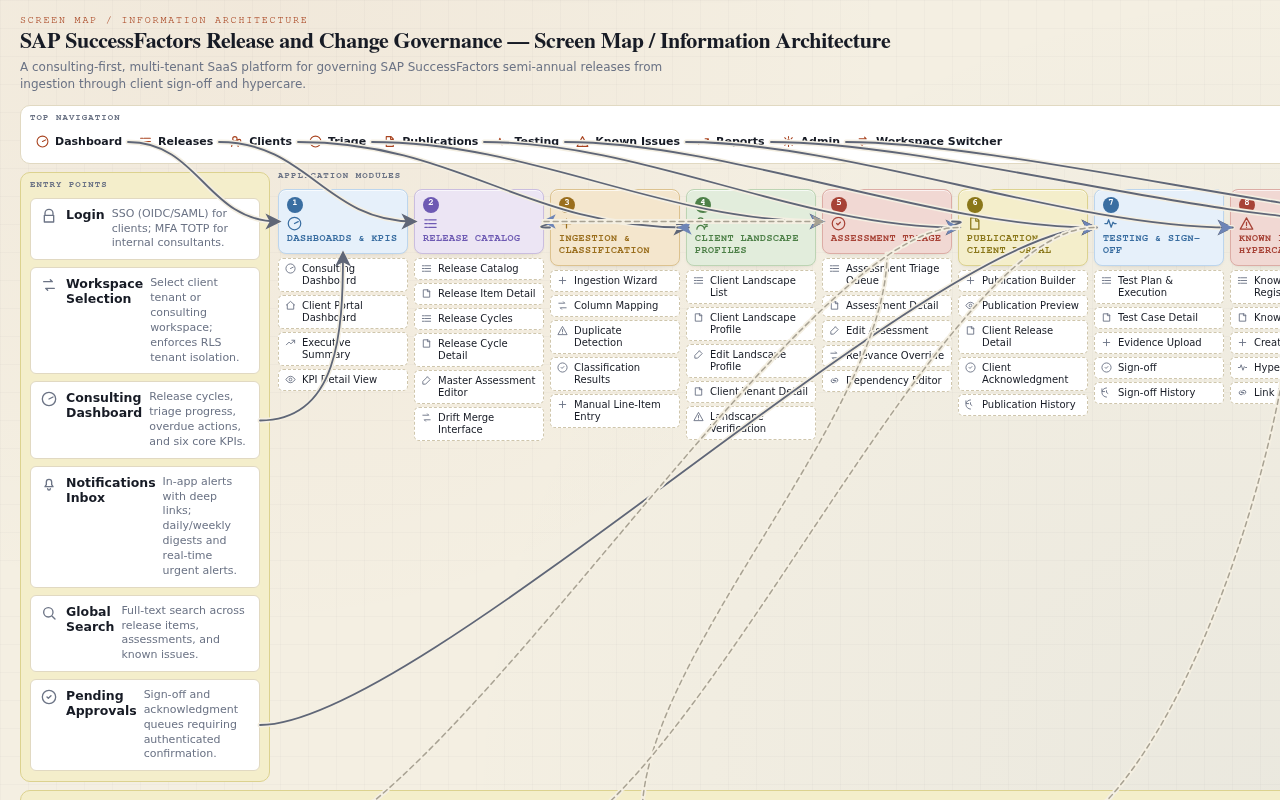
SAP SuccessFactors Release and Change Governance — Screen map
Project anatomy

Built with deepseek/deepseek-v4-pro-0813

22
Entities
26
DB tables
50
Screens
10
Modules
22
Models
25
Relations
9
Roles
15
Requirements
5
Journeys
0 comments
Log in to like, rate, or join the conversation. Log in
Original prompt

Create a multi-client SAP SuccessFactors Release and Change Governance application that helps consulting and support teams review changes, new features, deprecations, and universal updates from SAP What’s New (import per SAP release), decide internally which items are relevant for each client, and then publish only the selected items to that client’s secure workspace. Each client must see a configuration-specific view based on their enabled modules, countries, processes, integrations, environments, and previous decisions. Support roles such as platform administrator, release manager, module owner, integration lead, change manager, tester, support analyst, client administrator, and client viewer, with granular permissions for internal notes, client-visible information, approvals, comments, and evidence. Track every item from initial assessment through relevance decision, priority, cross-module impact, client communication, implementation planning, dependencies, interface or API changes, regression scope, test preparation, execution, deployment, hypercare, and closure, with owners, deadlines, status history, risks, decisions, attachments, related user guides, communication materials, and audit history. Provide release dashboards by client, module, priority, impact, readiness, overdue actions, testing progress, and unresolved dependencies, plus configurable notifications, reminders, approval workflows, search, filters, saved views, bulk updates, and Excel import/export for offline assessment and testing plans. Include a client follow-up area where clients can review published changes, acknowledge communications, comment, assign actions, confirm testing availability, access updated guides, and monitor progress without seeing internal evaluations. Add a Known Issues register where users can link records to subscribed SAP SuccessFactors Known Issues, associate issues with releases, clients, modules, environments, support tickets, workarounds, regression tests, and affected integrations, and record when a newly discovered issue has been raised in the SAP Support Portal. Integrate support ticketing system, prevent duplicate issue creation, maintain traceability between changes, incidents, SAP cases, tests, documents, and deployment decisions, and provide management reports, client-ready summaries, PDF or Excel exports, multilingual content, and a responsive mobile-friendly interface.

Discovery boards
Project Brief
What I think you want to build
A concise interpretation of the product intent and core value proposition.
interpretation

A multi-tenant governance platform for SAP consultancies and MSPs to ingest bi-annual release updates, curate per-client impact assessments in private, and publish tailored action plans into segregated client portals.

Accepted as primary value proposition.

recommendation

Focus initial design on the Consultancy/MSP operational model: one global catalog assessment syndicated dynamically across N client instances with per-client overrides.

Accepted operational model maximizing consulting efficiency.

tradeoff

Global feature assessment efficiency vs. bespoke client-specific nuance (e.g. custom MDF objects, bespoke integration flows).

Accepted trade-off to balance master assessment with client override flexibility.

hypothesis

Consultancies can reduce per-client release analysis labor by up to 60% through automated rule-based client matching (module + country tags).

Accepted hypothesis grounded in standard taxonomy filtering.

decision
critical

Adopt a two-tier workspace structure: Consulting Central Review Hub vs. Client Dedicated Portals.

Accepted structural separation protecting internal discussions from client visibility.

risk

Risk of overcomplicating simple release updates (e.g. minor UI label adjustments) with excessive governance bureaucracy.

Accepted operational risk.

decision

Master Catalog Override Propagation: When a global master assessment is edited post-syndication, should downstream client workspaces receive automated non-destructive patch suggestions or silent baseline updates?

Probing follow-up to master catalog adoption to prevent consultant changes from accidentally wiping out client-tailored notes.

tradeoff

MSP Multi-Client Centralization vs. Complete White-Labeling Branding per Client Portal.

Consulting firms frequently demand their own corporate branding alongside client-specific corporate themes.

Likely target users
Proposed primary user archetypes, roles, and collaborative context.
interpretation

Consulting Release Manager & Lead Architect: Oversees cross-client delivery schedules, ingests raw SAP release notes, assigns triage tickets to module leads, and monitors overall team progress.

Accepted primary persona.

interpretation

Functional Module Owner (e.g., Employee Central, Compensation, PMGM, Recruiting): Evaluates specific feature relevance, assesses configuration/data impacts, writes testing guidance, and creates client-facing explanations.

Accepted domain expert persona.

interpretation

Integration & Technical Lead: Assesses OData/SFAPI deprecations, middleware impact (CPI/Boomi), custom MDF objects, and security role permission changes.

Accepted technical persona.

interpretation

Client System Administrator / HRIS Lead: Reviews published releases in their client portal, confirms testing window dates, delegates functional test cases to internal testers, and signs off on deployment.

Accepted client-side persona.

interpretation

Support Analyst & Known Issue Custodian: Tracks active production incidents, links them to SAP Known Issues / KBA cases, and communicates workarounds to clients.

Accepted support persona.

recommendation

Enforce explicit Persona-based Navigation Layouts: Consulting internal roles see global release queues; client roles see an executive change summary and assigned action items.

Accepted persona navigation separation.

risk

Client HR stakeholders may abandon the portal if the interface is too dense with technical consulting jargon.

Accepted client adoption risk.

decision

Role Architecture: Provide the 9 required granular role definitions out-of-the-box with preset permission bundles for consulting and client teams, allowing rapid user assignment.

Revised with user edited content establishing 9 preset role bundles.

tradeoff

Client self-service user management vs. Consulting Admin provisioning of client accounts.

Allowing Client Admins to invite internal testers reduces consulting support overhead but requires strict seat limit controls.

Problems worth solving
Stated and unstated inefficiencies, risks, and operational bottlenecks.
interpretation

Release Overwhelm: Semi-annual SAP SuccessFactors releases contain hundreds of line items across dozens of modules, making manual Excel spreadsheet tracking chaotic and error-prone.

Accepted core operational problem.

interpretation

Cross-Client Contamination & Work Duplication: Consulting teams assess the exact same universal updates separately in 20 different client spreadsheets, duplicating hundreds of hours while risking accidental sharing of client data.

Accepted MSP operational bottleneck.

interpretation

Traceability Void: Lack of audit trails connecting an SAP deprecation notice to its impact assessment, test execution proof, client sign-off, and production deployment.

Accepted compliance gap.

interpretation

Known Issue Blindspots: Teams re-investigate recurring platform bugs without knowing SAP has already acknowledged a Known Issue or that another client team created a workaround.

Accepted support inefficiency.

risk

Client Disengagement: If clients receive 200 unfiltered release notes, they experience analysis paralysis and fail to complete mandatory regression testing before preview environment upgrades.

Accepted client fatigue risk.

recommendation

Introduce an automated 'Relevance Matrix Engine' that auto-excludes features for modules, countries, or configurations the client has not enabled.

Accepted core noise reduction mechanism.

tradeoff

Strict mandatory assessment gates vs. speed of delivery during short 4-week SAP Preview-to-Production release windows.

Accepted operational crunch trade-off.

decision

Client Sign-off Mechanism: Standardize on in-app authenticated confirmation click capturing user identity, timestamp, IP address, role, and approved release version within an immutable audit trail.

Revised per user reaction establishing authenticated audit log sign-off.

risk

Stale Client Landscape Profiles: If client landscape profiles are not updated after a mid-year module rollout or acquisition, the Relevance Engine will erroneously filter out critical updates.

Probing follow-up to manual landscape profiling model.

Desired outcomes
Measurable end-states and operational transformations post-implementation.
interpretation

Zero unreviewed universal updates reaching client production environments without prior risk assessment and communication.

Accepted primary governance outcome.

interpretation

Client release readiness sign-off achieved at least 7 business days prior to SAP production deployment weekend across 95% of accounts.

Accepted milestone target.

interpretation

100% bidirectional linkage between high-severity SAP post-release incidents and identified Known Issues or release items.

Accepted linkage metric.

recommendation

Provide instant one-click executive PDF/Excel 'Release Advisory Dossiers' customized with client branding and filtered to their specific modules.

Accepted reporting output.

risk

Clients may view the system as an unneeded layer if it does not directly save them time compared to reading raw PDF release decks.

Accepted client engagement risk.

decision

Notification Strategy: Daily/weekly batched email digests with deep links as default, combined with real-time in-app notification center alerts for urgent breaking updates.

Revised per user reaction establishing digest default plus real-time in-app alerts.

decision

Standardize on an aggregate Release Health Score (0-100%) metric per client dashboard to convey readiness at a glance.

Accepted KPI visualization standard.

hypothesis

Standardized test plan templates tied directly to release items will increase client test execution rates by over 40%.

Accepted testing hypothesis.

decision

Release Health Score Formula Weighting: How should test execution vs. executive acknowledgment vs. unresolved blocker count be weighted in the 0-100% calculation?

Probing follow-up to make the accepted Release Health Score operationally deterministic.

Usage context
Operational rhythm, release crunch windows, and environment interactions.
interpretation

Major Release Crunch Window: Concentrated high-intensity activity occurring twice per year (1H and 2H SAP release cycles) spanning the 4-6 weeks between Preview release and Production deployment.

Accepted operational cycle.

interpretation

Weekly / Monthly Maintenance & Patch Mode: Continuous lower-intensity triage for emergency patches, minor enhancement announcements, and known issue updates.

Accepted steady-state workflow.

interpretation

Collaborative Advisory Workshops: Consultants sharing screen or walking client leadership through the portal during live release review sessions.

Accepted consultative workflow.

interpretation

Mobile & On-the-Go Executive Acknowledgment: Client executives reviewing summary dashboards and approving releases via tablet or smartphone during transit.

Accepted mobile accessibility requirement.

risk

System performance degradation during peak release triage days when 50+ consultants perform simultaneous bulk updates and imports.

Accepted scaling risk during crunch periods.

recommendation

Provide robust offline capabilities: seamless Excel export for off-line client review / testing execution and reliable re-import diff engine.

Accepted Excel bi-directional sync capability.

decision

Concurrency Model: Optimistic record locking with visual collision indicators and concurrent edit warning banners during simultaneous consultant reviews.

Revised per user reaction specifying optimistic locking with collision warnings.

decision

Historical Release Lifecycle: Past release cycles are retained indefinitely in a searchable, read-only state post-hypercare sign-off.

Revised per user reaction establishing indefinite searchable retention.

tradeoff

Offline Excel Re-import Conflict Resolution: Silent overwrite based on latest file timestamp vs. cell-by-cell visual diff review modal.

Probing follow-up to accepted Excel export/re-import capability.

Scope boundaries
Clear guardrails establishing what the application intentionally is NOT.
constraint
critical

NOT an Automated Test Execution Engine: The platform will manage test plans, test cases, and sign-offs, but will NOT execute automated UI/API regression scripts directly against SAP tenants.

Accepted core boundary.

constraint

NOT a Full-Scale ITSM Replacement: The system links to ServiceNow/Jira tickets and SAP Support cases via Reference IDs, but does NOT replace standard enterprise helpdesk ticket lifecycles.

Accepted ITSM scope boundary.

constraint
critical

NOT an Automated SAP Transport / Package Deployment Tool: It governs the decision to deploy and tracks deployment checklist completion, but does not deploy MDF XML or Provisioning settings into SAP.

Accepted Provisioning scope boundary.

recommendation

Exclude custom LMS video hosting; link out to existing customer learning management systems or secure cloud storage for video guides.

Accepted media storage constraint.

risk

Scope creep caused by trying to support other ERP ecosystems (Workday, Oracle Cloud HCM) in Phase 1 before mastering SuccessFactors nuances.

Accepted phase 1 ERP boundary.

decision

Knowledge Documentation: Provide native rich-text and markdown editor for release executive summaries and impact guidance, combined with secure external links to customer SharePoint/Confluence/LMS repositories.

Revised per user reaction establishing hybrid rich-text and cloud link storage.

decision

Client Landscape Profiling: Client configuration profiles (modules, sub-modules, countries, active integration flows) are configured manually during onboarding via a structured landscape template.

Revised per user reaction establishing structured onboarding template profiling.

hypothesis

Restricting Phase 1 strictly to SuccessFactors will allow launch within 3 months, whereas multi-ERP support would delay launch to 9+ months.

Accepted scope focus hypothesis.

constraint

No Direct SAP Tenant Credential Storage: Platform will not store SAP S-User passwords, Provisioning credentials, or API secret keys in Phase 1.

Probing follow-up eliminating major security and compliance liability in Phase 1.

Blind spots and risks
Technical, adoption, operational, and compliance hazards.
risk
critical

Internal Consulting Data Leakage: An internal assessment comment (e.g. 'Client configuration is broken due to past poor implementation') being accidentally published or visible in the client workspace.

Accepted critical confidentiality risk.

risk

Unpredictable SAP What's New Formatting: SAP changing their release note taxonomy, HTML structure, or CSV export format between releases, breaking automated ingestion parsers.

Accepted format variability risk.

risk

Low Client Portal Adoption: Client stakeholders preferring to receive an email summary or slide deck rather than logging into another portal with separate credentials.

Accepted user adoption risk.

risk

SAP Support Portal Scraping / API Restrictions: SAP's Launchpad / Support Portal having strict authentication barriers or anti-scraping controls that limit automated Known Issue synchronization.

Accepted integration hurdle risk.

recommendation
critical

Implement hard architectural separation between 'Internal Review Draft' entities and 'Client Published Document' entities rather than relying on a single 'is_public' boolean flag.

Accepted defense-in-depth entity isolation pattern.

decision

Assessment Validation: Staged validation lifecycle allowing permissive rapid ingestion into 'Draft', with mandatory field enforcement (module, risk, test impact) required before marking 'Assessment Complete' or publishing to clients.

Revised per user reaction establishing staged validation gates.

decision

Client Authentication: Provide SAML 2.0 / OIDC Enterprise SSO integration for client organizations alongside passwordless secure magic link email authentication for client viewers.

Revised per user reaction establishing SSO plus magic links.

hypothesis

Providing automated weekly digest emails with direct deep-links will increase client login rates by 3x during release windows.

Accepted engagement hypothesis.

risk
critical

Cross-Tenant File Attachment Bleed: Uploaded customer test scripts or data models stored in shared S3 buckets without tenant-scoped prefix encryption and pre-signed token validation.

Probing follow-up on file uploads within multi-tenant MSP environment.

High-impact decisions
Structural architectural and functional choices requiring explicit confirmation.
decision
critical

Multi-Tenant Architecture Pattern: Shared database architecture utilizing strict PostgreSQL Row-Level Security (RLS) with tenant isolation, tenant-specific encryption keys for client-published content, and logical segregation between internal consulting entities and client-facing entities.

Revised per user reaction and confirmed as core architectural standard.

decision

SAP Release Ingestion: Implement an XLSX/CSV Import Wizard with visual column mapping, pre-flight header validation, automated duplicate detection, and manual line-item entry fallback.

Revised per user reaction and confirmed as ingestion foundation.

decision

ITSM and SAP Portal Integration Depth: Phase 1 provides structured reference IDs, URL deep linking, and external ticket status badges (ServiceNow, Jira, SAP Launchpad KBA cases), architected for bidirectional REST/webhook sync in future releases.

Revised per user reaction and confirmed as Phase 1 integration scope.

decision

Client Customization Model: A standardized hierarchical taxonomy representing SuccessFactors modules (EC, PMGM, RCM, EC Payroll, LMS, etc.), sub-features, localized countries, and integration endpoints.

Revised per user reaction and confirmed for landscape mapping.

recommendation
critical

Default to a 'Master Release Catalog' where consultants assess an SAP item once globally, then apply client-specific overrides only where configurations diverge.

Accepted recommendation maximizing assessment reuse across accounts.

decision

Multilingual Translation Strategy: English baseline catalog with AI-assisted machine draft translation for client-facing notes, allowing consultant human review and curation before publishing.

Revised per user reaction establishing machine-assisted human-curated localization.

risk

Choosing an inflexible data model that cannot accommodate non-SuccessFactors SAP products (e.g., S/4HANA Cloud, Ariba, Fieldglass) if the business expands later.

Accepted extensible data model requirement.

hypothesis

Consultancies will willingly pay per-active-client-seat if the platform delivers automated release dossier exports and compliance audit histories.

Accepted monetization hypothesis.

decision

Audit Log Immutability Architecture: Standard database audit triggers vs. append-only cryptographic ledger / hash-chained audit storage.

Probing follow-up to support enterprise compliance sign-off requirements.

Needs & Data
Core domain objects
What entities exist in the product world, their key attributes, and domain relationships.
interpretation
critical

Master Release Cycle (ID, Code [e.g. 1H 2025], Target Year, Half, Preview Date, Production Date, Lifecycle State [Draft, Active Triage, Published, Historical Read-Only], Ingested Item Count).

Root entity anchoring semi-annual release schedules across all consulting and client workflows.

interpretation
critical

Master Release Item (ID, Release Cycle ID, SAP Feature ID, Title, Module, Sub-Module, Feature Category [Universal, Admin Opt-In, Deprecation], Description, SAP Documentation URL, Consulting Master Assessment RichText, Global Risk Level [Low, Med, High, Critical], Master Test Template, Version Number).

Represents the canonical SAP What's New record ingested from SAP and centrally evaluated by module leads.

interpretation
critical

Client Tenant & Profile (Tenant ID, Client Name, Industry, Primary Region, SLA Tier, Active Status, Onboarding Date, Storage Prefix).

Represents the client enterprise organization for multi-tenant data boundaries and storage partitioning.

interpretation

Client Landscape Config (ID, Client Tenant ID, Module Code [relational FK], Country ISO Code [relational FK], Environment Type [Preview, Test, Prod], JSONB Extension Attributes [Sub-features, custom MDF objects, Integration Endpoints], Active Boolean, Last Verified Date).

Granular landscape inventory implementing confirmed hybrid relational/JSONB architecture.

interpretation
critical

Client Release Assessment (ID, Client Tenant ID, Master Release Item ID, Relevance Status [Auto-Excluded, Under Review, Applicable, Defer], Client-Specific Impact Note, Internal Consulting Risk Rating, Regression Scope, Action Owner ID, Review State, Synced Master Version, Drift Status [In-Sync, Update Available]).

Consultant triage layer where master items are customized per client with drift tracking.

interpretation
critical

Published Client Package Item (ID, Client Release Assessment ID, Client Tenant ID, Public Title, Executive Summary, Client Action Required [Yes/No], Action Deadline, Published Version, Published At, Published By User ID, Client Acknowledged State).

Client-facing published record completely decoupled from internal consulting draft notes.

interpretation

Release Sign-off & Acknowledgment (ID, Client Tenant ID, Release Cycle ID, Sign-off Type [Preview Testing Acknowledged, Production Go-Live Approved], Signer User ID, Signer Role, Authenticated Timestamp, IP Address, Audit Hash, Previous Hash, Comments).

Provides formal compliance records verifying executive client authorization with SHA-256 hash chaining.

interpretation

Known Issue & Incident Link (ID, SAP KBA/Issue ID, Title, Summary, Severity, Affected Modules, Workaround RichText, SAP Status [Investigating, Fix in Preview, Resolved], Client Ticket Reference ID, ITSM URL Deep Link).

Tracks known SAP platform defects, workarounds, and cross-references external ITSM tickets.

interpretation

Release Test Case (ID, Client Release Assessment ID, Test Scenario Title, Expected Result, Test Type [Smoke, Regression, Integration], Assigned Tester User ID, Execution Status [Not Started, Passed, Failed, Blocked], Test Evidence Attachment ID, Executed At, Optimistic Lock Version).

Captures functional test planning and proof of verification tied directly to release items.

User-provided inputs
Data the future app will ask from users, complete with field types and validations.
recommendation

SAP Release Ingestion Payload: Multipart XLSX/CSV file upload (max 50MB) + visual column mapping configuration (Release Item ID, Module, Title, Description, Type).

Mandatory input schema for bi-annual What's New catalog creation.

recommendation

Client Landscape Matrix: Relational pickers for Enabled Modules and ISO-3166 Country Codes, paired with JSON editor/tag inputs for custom Sub-features and Integration Endpoints.

Required onboarding inputs supporting confirmed hybrid landscape data model.

recommendation

Consultant Internal Assessment: Structured form with fields: Relevance Override (enum), Implementation Complexity (1-5 scale), Customization Risk (Low/Med/High/Crit), Internal Private Notes (RichText, required for High/Crit risk), Regression Guidance (RichText).

Captures expert triage data prior to publishing.

recommendation

Client Publication Payload: Form capturing Client-Facing Summary (RichText, max 4000 chars), Action Required Flag (Boolean), Target Completion Date (Date, must be >= today), Assigned Client Stakeholder (User ID).

Sanitized client-ready content authored by change managers.

recommendation

Known Issue & Case Linkage: Form capturing SAP Case Reference ID (regex ^[0-9]{10}$), External ITSM Ticket URL (valid URL format), Severity (P1/P2/P3/P4), Workaround Text (RichText), and Affected Client Multiselect.

Structured inputs ensuring validated linking to external SAP and ticketing systems.

recommendation

Formal Sign-off Submission: Checkbox confirmation, Legal Acknowledgment Statement, Digital Identity Confirmation (User Password/MFA re-auth check), and Sign-off Note (optional text).

Explicit user action providing non-repudiation inputs for cryptographic hash logging.

recommendation

Three-Way Diff Review Modal: Interactive side-by-side comparison modal displaying Master Update vs Current Client Assessment vs Base Version, with field-level 'Accept Master' or 'Keep Client' buttons.

Directly implements confirmed decision dec_data_001 for selective update propagation.

System-derived data
Data calculated, aggregated, or inferred by the system without direct entry.
interpretation
critical

Automated Relevance Classification: Computed status ('Auto-Applicable', 'Auto-Excluded', 'Manual Review Needed') derived from matching item module/country tags against Client Landscape Config.

Eliminates manual triage for obvious out-of-scope release items.

interpretation

Release Readiness Health Score (0-100%): Derived aggregate calculated as (0.40 * Test Pass Rate) + (0.30 * (1 - Open Blocker Ratio)) + (0.20 * Signoff Progress) + (0.10 * Dependency Resolution Rate).

Implements confirmed decision dec_data_003 providing weighted composite KPI.

interpretation

Days Until Production Cutover: Countdown integer calculated as (ReleaseCycle.production_date - current_date). Triggers escalation badge when < 14 days and health score < 80%.

Drives urgency and automated reminder notifications across active releases.

interpretation

Triage Velocity & Completion Percentage: Computed metrics per module and per client: (Reviewed Items / Total Applicable Items) * 100 and (Published Items / Total Applicable Items) * 100.

Provides operational management visibility into consulting team progress.

interpretation

Master Catalog Drift Flag: Boolean flag (is_master_drifted) derived when Master Release Item.version > Client Release Assessment.synced_master_version, highlighting downstream records needing re-evaluation.

Alerts consultants when global guidance has evolved post-initial triage.

interpretation

Audit Chain State Hash: Derived SHA-256 checksum calculated over (previous_hash + record_payload + signer_user_id + timestamp + client_ip) on every sign-off and publication event.

Provides tamper-evident cryptographic verification of release governance actions.

Business rules and decision logic
Machine-checkable assertions, validation criteria, scoring rules, and lifecycle gates.
constraint
critical

Publication Gate: A Client Release Assessment CANNOT be published to a client portal unless: (1) Relevance Status is set to 'Applicable', (2) Client-Facing Summary is non-empty, and (3) Internal Risk is categorized.

Prevents premature or unreviewed technical records from leaking to clients.

constraint
critical

Tenant Isolation Enforcement: All SELECT, UPDATE, DELETE queries on client workspaces MUST evaluate PostgreSQL RLS policy `tenant_id = current_setting('app.current_tenant_id')`.

Guarantees cross-tenant data isolation at the database engine level.

constraint

Immutable Audit Requirement: Records in `release_sign_offs` and `audit_log_entries` are append-only; hard DELETE and UPDATE operations are prohibited by PostgreSQL database triggers.

Ensures compliance validity and forensic integrity for enterprise governance.

constraint

Universal Feature Mandate: Any SAP Release Item flagged as 'Universal' by SAP CANNOT be marked as 'Auto-Excluded' unless the client does not own the parent module.

Universal updates are forced by SAP; clients cannot opt out if the module is active.

constraint

Sign-off Pre-requisite Gate: Client Production Sign-off cannot transition to 'Approved' while any associated High/Critical Test Case remains in 'Failed' or 'Blocked' state without an approved override.

Guarantees technical release governance by preventing unverified go-lives.

constraint

Optimistic Concurrency Lock: When saving test executions or assessment edits (via Web or Excel re-import), if `updated_at` on DB > submitted `base_version_timestamp`, reject write and open visual diff reconciliation.

Implements confirmed concurrency strategy to prevent silent overwriting during crunch periods.

Knowledge and data dependencies
External data schemas, template dependencies, reference taxonomies, and integration formats.
interpretation

SAP What's New Schema Specification: Dependency on semi-annual SAP SuccessFactors XLSX/CSV column header specifications (Feature Title, Module, Feature ID, Enablement Type, Technical Reference).

The ingestion parser depends on structural stability or flexible visual mapping of SAP's official export files.

interpretation

Standardized SuccessFactors Taxonomy Master: Master list of 24 core modules (EC, PMGM, RCM, ONB, LMS, Comp, Succession, EC Payroll, etc.), sub-components, and ISO-3166-1 country codes.

Essential canonical taxonomy for matching release notes to client landscape configurations.

interpretation

External Ticket Deep Link URI Schemas: Predefined URL pattern templates for ServiceNow (`https://{instance}.service-now.com/nav_to.do?uri=incident.do?sys_id={id}`), Jira, and SAP Launchpad (`https://me.sap.com/notes/{id}`).

Enables one-click navigation to external systems without direct API integration.

interpretation

Offline Excel Assessment Template Definition: Strict column schema with cryptographic template hash and locked cell protections to support offline bulk reviews and reliable re-ingestion diffs.

Ensures consultants and clients can work offline during travel or crunch windows without corrupting data upon re-upload.

interpretation

Cloud Storage S3 IAM & KMS Hierarchy: S3 bucket layout structured as `s3://app-storage/{tenant_id}/{release_cycle_id}/` governed by server-side STS pre-signed URL generation.

Directly implements the user-confirmed storage isolation pattern.

Data risks
Vulnerabilities around privacy, PII, data quality, stale records, and human error fallbacks.
risk
critical

Cross-Tenant Attachment Leakage: Risk mitigated by enforcing S3 bucket path prefixes keyed by Client Tenant ID paired with server-side generated 15-minute expiring pre-signed URLs.

User confirmed specific architecture resolution eliminating accidental cross-tenant document visibility.

risk

Stale Client Landscape Profile: Client enables a new SuccessFactors module (e.g. Recruiting) mid-year without updating their profile, causing the engine to auto-exclude all new Recruiting release updates.

Data quality risk leading to unmanaged production breakages on deployment weekend.

risk

SAP Ingestion Schema Mutation: SAP modifies column names or splits module categories in a new release export, causing file ingestion failures or corrupting field assignments.

External data risk that could stall consulting operations on release announcement day.

risk

User Overwrite Collision in Offline Excel Re-import: Mitigated via optimistic concurrency with version timestamps and a visual row-by-row diff comparison modal when web records changed during offline editing.

User confirmed specific technical mitigation strategy for Excel re-upload collisions.

risk

Accidental PII Ingestion in Test Evidence: Testers upload screenshots containing unmasked employee names, compensation data, or national IDs into test case execution evidence.

Data privacy violation (GDPR/HIPAA/CCPA) when storing real employee records in governance tools.

risk

Consultant Alert Fatigue on Master Catalog Drift: Frequent minor cosmetic edits to master items trigger dozens of 'Update Available' badges across hundreds of client assessments.

Probed operational risk: high volume of diff alerts may lead consultants to ignore important functional updates.

Open data decisions
High-impact data modeling and architecture choices requiring team confirmation.
decision

Downstream Master Catalog Synchronization: Flag syndicated items as 'Update Available' with visual diff merge so consultants can pull global updates without clobbering client customizations.

User accepted and confirmed three-way visual diff merge strategy.

decision

Client Landscape Model: Adopt hybrid model using relational tables for core modules and country ISOs with JSONB documents for extensible sub-features and integration endpoints.

User accepted and confirmed hybrid schema architecture.

decision

Release Health Score Formula: Use weighted index formula (40% Test Pass Rate, 30% Open Blockers, 20% Sign-offs, 10% Dependency Resolution) to provide composite score.

User accepted and confirmed weighted index formula.

decision

Audit History Retention and Immutability: Implement trigger-based append-only audit tables with cryptographic hash chaining (SHA-256) directly within PostgreSQL.

User accepted and confirmed PostgreSQL trigger-based cryptographic audit logging.

decision

Master Catalog Drift Materiality Threshold: What triggers an 'Update Available' notification to client assessment owners?

Determines whether every minor typo in master catalog triggers a notification or only material risk/scope edits.

decision

Test Evidence Retention Policy: How long should uploaded screenshot test evidence be retained in S3 before auto-archiving or purging?

Balances compliance audit defense with storage costs and GDPR data minimization principles.

Solution Shape
Recommended product concept
A concise product thesis the user can endorse or reject, with a decision on positioning alternatives.
interpretation
critical

A two-sided governance platform for SAP consultancies and MSPs: a consulting-side release triage and assessment hub paired with a client-side tailored change communication and sign-off portal, unified by a master release catalog and per-client landscape profiles.

Synthesized from confirmed project brief and needs_data boards; user explicitly endorsed two-tier workspace structure and master catalog syndication.

decision

Position the product as consulting-first: internal consultants are the primary users, and the client portal is a secondary view tailored to their needs. Alternative: client-first portal with consulting back-office.

User explicitly confirmed consulting-first positioning in blocker answer and accepted this element.

risk

Risk: Consulting-first positioning may lead to underinvestment in client portal UX, reducing client acknowledgment and engagement. Mitigation: allocate dedicated UX budget for client portal and treat it as a first-class experience.

Follow-up risk surfaced by acceptance of consulting-first positioning; needs explicit mitigation commitment.

Main user journey
Recommended end-to-end flow from release ingestion to production sign-off, with risks and decisions about step ordering.
recommendation

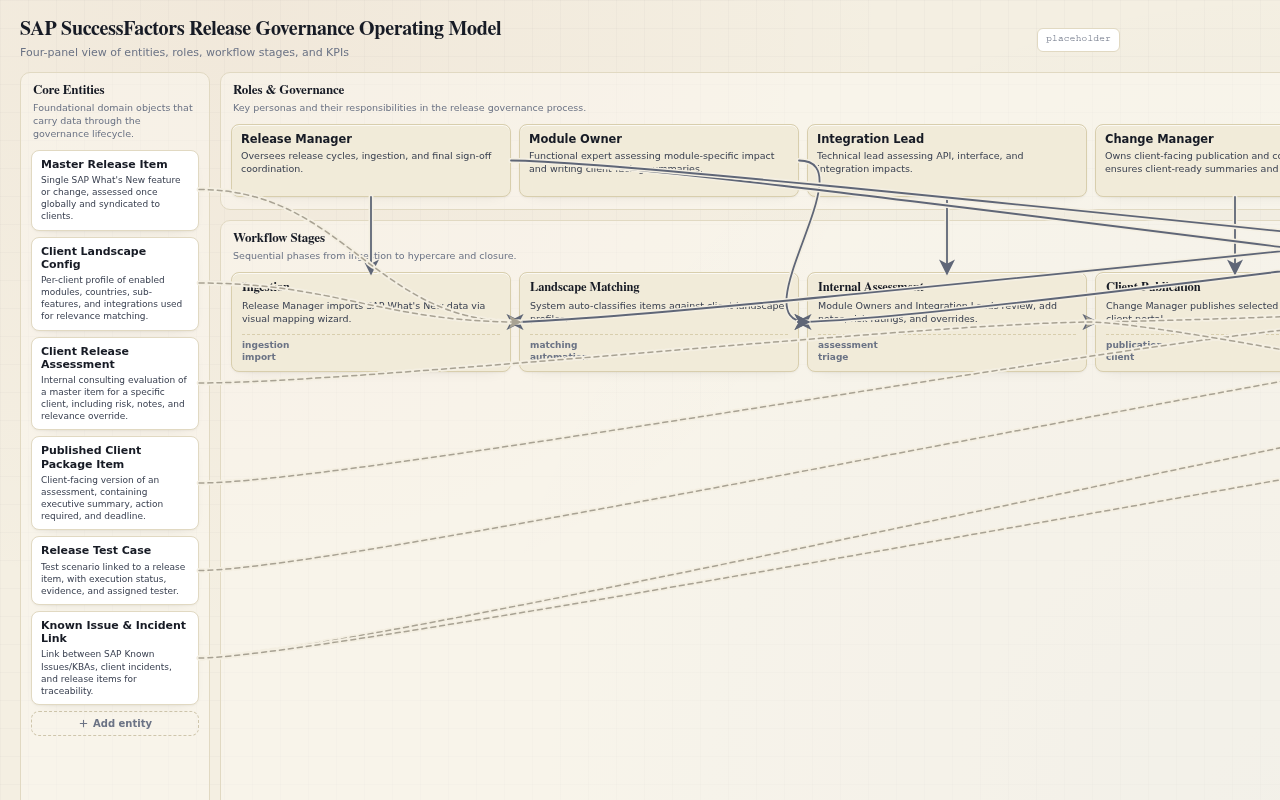
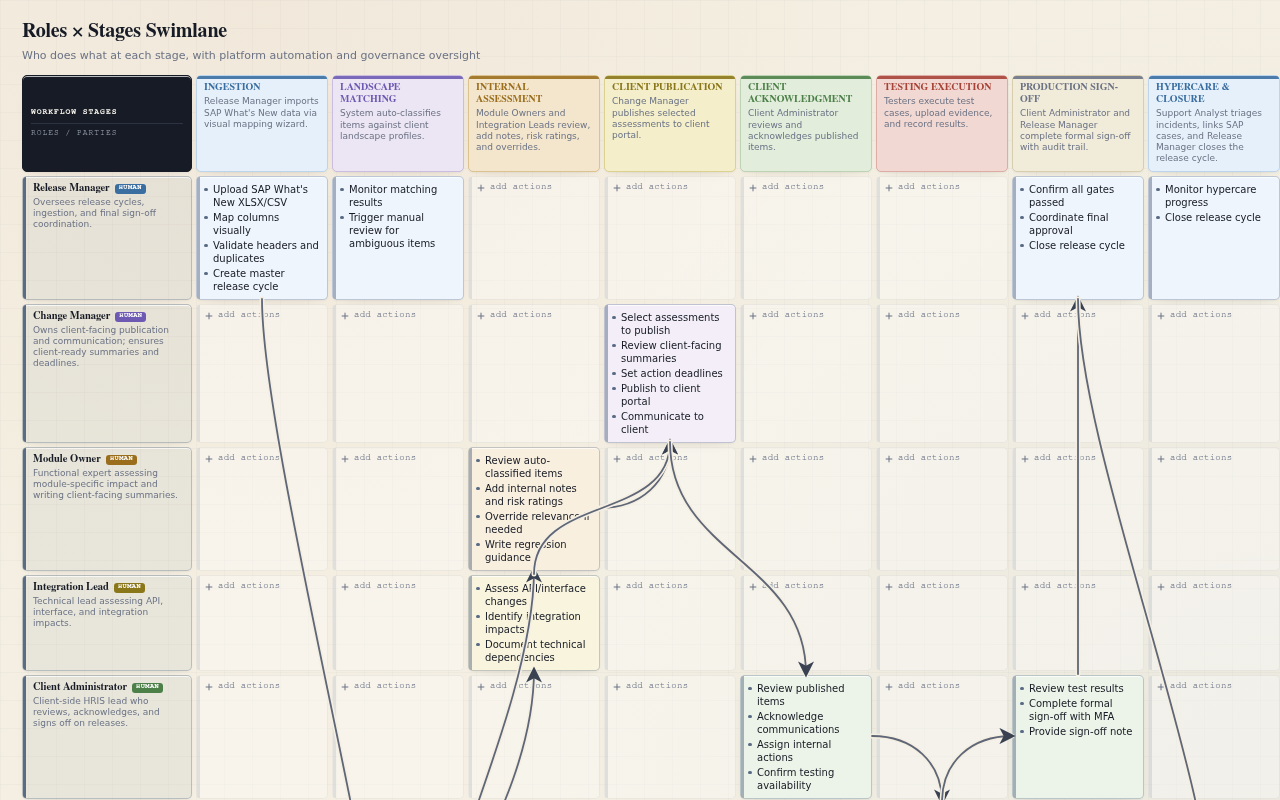
Step 1: Release Manager ingests SAP What's New XLSX/CSV via visual mapping wizard; system creates Master Release Cycle and Items.

Confirmed ingestion strategy from dec_002.

recommendation

Step 2: System auto-classifies each Master Release Item against each Client Landscape Profile, producing Auto-Applicable, Auto-Excluded, or Manual Review Needed.

Confirmed relevance engine from claim_data_003.

recommendation

Step 3: Module Owners and Integration Leads review auto-classified items, add internal notes, risk ratings, and regression guidance; they may override relevance status.

Confirmed internal assessment workflow from needs_data board.

recommendation

Step 4: Release Manager publishes selected assessments to client portal as Published Client Package Items with client-facing summaries and action deadlines.

Confirmed publication gate from business_rules.

recommendation

Step 5: Client Administrator and Viewers review published items, acknowledge communications, assign internal actions, and confirm testing availability.

Confirmed client follow-up area from original prompt.

recommendation

Step 6: Testers execute test cases linked to release items, upload evidence, and record pass/fail/blocked statuses.

Confirmed test case entity and execution status from needs_data board.

recommendation

Step 7: Client Administrator and Release Manager complete formal production sign-off with authenticated confirmation, captured in immutable audit trail.

Confirmed sign-off pre-requisite gate and audit mechanism from dec_data_004.

risk

Risk: The seven-step journey may be too linear for real-world parallel work; consultants often assess items while clients test earlier releases. Mitigation: allow concurrent phases with clear status indicators.

User acknowledged release crunch windows with overlapping activities and accepted this risk.

decision

Should client acknowledgment occur before or after testing execution? Current proposal: acknowledgment before testing, but testing availability confirmation is part of acknowledgment.

User explicitly confirmed acknowledgment before testing in blocker answer and accepted this element.

decision

Should client acknowledgment be per-item or bulk per release? Proposed: bulk acknowledgment per release with optional per-item exceptions for high-impact changes.

Follow-up decision opened by confirmation of acknowledgment before testing.

Capability groups
Feature clusters organized by user goal, covering the full validated scope.
recommendation

Release Catalog Management: ingestion wizard, master release cycles, master items, versioning, drift detection, three-way diff merge.

Covers confirmed ingestion and catalog synchronization features.

recommendation

Client Landscape & Relevance: landscape profile configuration, hybrid relational/JSONB storage, automated relevance classification, manual overrides.

Confirmed hybrid model and relevance engine.

recommendation

Assessment & Triage: internal assessment forms, risk ratings, regression scope, dependencies, interface/API change tracking, implementation planning, action owners, bulk updates, Excel import/export.

User edited this element to include dependencies, interface/API change tracking, and implementation planning, closing the lifecycle completeness gap.

recommendation

Client Publication & Portal: publication gate, client-facing summaries, action deadlines, client acknowledgment, comments, secure workspace.

Confirmed publication gate and client follow-up area.

recommendation

Testing, Deployment & Closure: test case management, execution tracking, evidence upload, sign-off pre-requisite gates, deployment tracking, hypercare monitoring, closure workflow, audit trail.

User edited this element to include deployment tracking, hypercare monitoring, and closure workflow, closing the lifecycle completeness gap.

recommendation

Known Issues & Support: known issue register, SAP KBA linkage, ITSM reference IDs, workarounds, duplicate prevention.

Confirmed known issue register and ITSM integration boundary.

recommendation

Dashboards & Reporting: release dashboards by client/module/priority, health score, overdue actions, executive PDF/Excel exports.

Confirmed dashboard requirements and release health score formula.

recommendation

Administration & Security: RBAC with nine roles, RLS, field-level security, audit logging, tenant isolation, notifications.

Confirmed role architecture and security requirements.

decision

Should Known Issues be a separate capability group or merged into Support? Current proposal: separate group for clarity.

User accepted separate group; decision is now confirmed.

decision

Should dependencies be modeled as first-class entities with directional links (blocks/is-blocked-by) or as tagged references on items? Proposed: first-class dependency entity for critical dependencies, tags for informational.

Follow-up decision opened by user's edit adding dependencies to Assessment & Triage.

decision

Should hypercare duration be configurable per client/release or fixed? Proposed: configurable per release with a default of 2 weeks, overridable per client.

Follow-up decision opened by user's edit adding hypercare monitoring to Testing, Deployment & Closure.

Optional phase-1 cut
Recommended phase-1 cut, ONLY when the user wants a staged rollout. Leave empty otherwise.
recommendation

User has not requested a staged rollout; full validated spec is the target.

Later extensions
Features valuable after MVP, not part of the initial full spec.
opportunity

Bidirectional ITSM synchronization via REST/webhooks (currently reference IDs only).

Confirmed Phase 1 boundary; full sync is a natural later extension.

opportunity

Automated test execution integration with SAP testing tools (e.g., Tricentis, Panaya).

Explicitly out of scope in Phase 1 but valuable later.

opportunity

Support for other SAP products (S/4HANA Cloud, Ariba, Fieldglass) using the same governance model.

User acknowledged potential expansion; current scope is SuccessFactors only.

opportunity

AI-assisted translation of client-facing notes into multiple languages with human review.

Confirmed multilingual requirement; AI translation is a later enhancement.

Explicitly excluded scope
Things to not build now, explicitly rejected.
constraint
critical

No automated SAP transport or package deployment; the platform governs decisions but does not execute deployments.

Explicitly excluded in project brief scope boundaries.

constraint

No full ITSM replacement; the system links to ServiceNow/Jira via reference IDs and deep links only.

Explicitly excluded in project brief scope boundaries.

constraint

No direct SAP tenant credential storage (S-User passwords, Provisioning credentials, API secret keys).

Proposed in project brief; user has not rejected, so treat as accepted.

constraint

No custom LMS video hosting; link out to existing learning management systems or secure cloud storage.

Explicitly excluded in project brief scope boundaries.

Trade-offs and tensions
Conflicts requiring resolution, each with a recommended position.
tradeoff

Governance strictness vs. release crunch speed: strict gates ensure compliance but may delay low-risk items. Recommended: severity-based bypass with configurable thresholds and full audit logging.

User explicitly confirmed severity-based bypass with configurable thresholds and audit logging in blocker answer and accepted this element.

tradeoff

Global master catalog efficiency vs. client-specific nuance: assessing once globally saves time but may miss client-specific customizations. Recommended: master catalog with per-client overrides and drift detection.

Confirmed master catalog approach; drift detection mitigates staleness.

tradeoff

Client portal simplicity vs. technical depth: too much detail overwhelms clients; too little leaves them uninformed. Recommended: progressive disclosure with executive summaries and drill-down.

User identified client disengagement risk; progressive disclosure is a standard mitigation.

tradeoff

Offline Excel support vs. real-time collaboration: offline editing enables crunch work but creates sync conflicts. Recommended: optimistic concurrency with visual diff merge.

Confirmed offline capabilities and concurrency model; diff merge resolves conflicts.

tradeoff

Automated relevance matching vs. manual review: automation reduces effort but may misclassify edge cases. Recommended: auto-classify with manual override and confidence indicators.

Confirmed relevance engine; manual override is essential for trust.

tradeoff

Bypass threshold granularity vs. audit consistency: per-client thresholds increase flexibility but complicate cross-client reporting. Recommended: global defaults with client-level overrides, all changes audit-logged.

Follow-up tradeoff opened by confirmation of severity-based bypass.

tradeoff

Offline Excel conflict resolution: when import conflicts with server state, who resolves? Recommended: importing user resolves with visual diff, release manager can override.

Follow-up tradeoff opened by acceptance of optimistic concurrency with diff merge.

Design principles
UX/product principles inferred from the validated context.
recommendation
critical

Segregation of internal and client views: never mix consulting notes with client-facing content; use separate entities and RLS.

Critical to prevent data leakage; confirmed in architecture.

recommendation

Progressive disclosure: show high-level summaries first, allow drill-down for details, especially in client portal.

Reduces overwhelm and increases adoption.

recommendation

Auditability first: every state change and sign-off must be captured in an immutable audit trail with user identity and timestamp.

Confirmed compliance requirement.

recommendation

Offline-first for crunch windows: support Excel export/import and optimistic concurrency to handle peak release periods.

Confirmed offline capabilities and usage context.

decision

Should progressive disclosure be a core design principle, or should we provide separate executive and technical portals?

User accepted progressive disclosure as core principle; decision is now confirmed.

decision

Which client-facing fields are executive summary vs technical detail? Proposed: impact summary, action required, deadline = executive; regression scope, test cases, technical notes = drill-down.

Follow-up decision opened by acceptance of progressive disclosure as a core principle.

Spec Map
Product overview
A concise summary of what the product is, its value proposition, and key positioning decisions, with risks and tradeoffs surfaced for validation before formal specification lock-in. This section anchors the entire spec map and must be unambiguous for all downstream sections to reference consistently. It includes the product concept, target users, core value, scope boundaries, and the governance-vs-speed tradeoff that shapes every workflow and business rule. Each element is either a confirmed claim from prior boards or a new proposal requiring explicit user acceptance in this round. The section deliberately includes at least one risk and one tradeoff to force early alignment on the most contentious design tensions. The product overview is not a restatement of the original prompt; it is a synthesized, decision-ready statement of intent that the user can endorse or refine before we proceed to detailed functional decomposition.
interpretation
critical

The product is a consulting-first, multi-tenant SaaS platform for SAP SuccessFactors release governance, with a two-sided architecture: an internal consulting hub and segregated client portals.

Directly derived from confirmed claim_sol_001 and dec_sol_001.

interpretation

The platform reduces per-client release analysis labor by up to 60% through automated rule-based client matching (module + country tags).

Confirmed in project_brief product_intention.

interpretation

The platform supports semi-annual SAP release cycles with a compressed 4-6 week crunch window between Preview and Production.

Confirmed in usage_context.

tradeoff

The platform must balance strict governance gates against release crunch speed, using severity-based bypass with configurable thresholds and full audit logging.

Confirmed in dec_sol_004.

risk

Risk: Client portal adoption may be low if clients perceive the portal as an extra layer rather than a time-saver. Mitigation: dedicated UX budget, progressive disclosure, and weekly digest emails with deep links.

Identified in project_brief risks.

decision

Should the client portal be treated as a first-class experience with equal UX investment as the consulting hub, or as a secondary view? Current proposal: first-class experience to drive adoption.

User accepted first-class experience; confirmed as the right call for adoption and acknowledgment rates.

constraint

The platform is scoped to SAP SuccessFactors only in Phase 1; multi-ERP support (Workday, Oracle) is explicitly excluded.

Confirmed in scope_boundaries.

opportunity

Opportunity: The platform can become the system of record for release governance across all SAP products (S/4HANA, Ariba, Fieldglass) if the data model remains extensible.

User accepted this opportunity as a future expansion path.

decision

Should the platform adopt a white-label branding option per client portal, or maintain a single MSP brand? Current proposal: single MSP brand with client-specific content, white-label deferred.

User accepted single MSP brand with client-specific content; white-label deferred.

risk

Risk: Overcomplicating simple release updates with excessive governance bureaucracy may frustrate consultants. Mitigation: severity-based bypass and configurable thresholds.

Identified in product_intention risks.

User roles
Defines all user roles in the system, their responsibilities, and the rationale for role separation. This section must align with the confirmed role list from prior boards and the operating model (if available). Each role is described with enough specificity to derive permissions in the permissions section. The section includes decisions about role boundaries (e.g., Change Manager vs Release Manager) and risks around role proliferation or ambiguity. It also surfaces open questions about client self-service user management and authentication, which are critical for the permissions model. The goal is to ensure every role has a clear, non-overlapping mandate that can be enforced through RBAC and field-level security.
interpretation
critical

The platform defines nine distinct roles: Platform Administrator, Release Manager, Module Owner, Integration Lead, Change Manager, Tester, Support Analyst, Client Administrator, and Client Viewer.

Roles explicitly listed in original prompt and confirmed in prior boards.

interpretation

Change Manager is a separate role from Release Manager, owning client-facing publication and communication, while Release Manager retains release cycle oversight and final sign-off coordination.

Confirmed in dec_new_change_manager.

interpretation

Support Analyst participates in Production Sign-off to confirm known issues/workarounds and in Hypercare & Closure to triage incidents and link SAP cases.

Confirmed in claim_new_support_analyst.

decision

Should client self-service user management be allowed, or should consulting admin provision all client accounts? Current proposal: consulting admin only in Phase 1.

User accepted consulting admin only in Phase 1; client self-service deferred to Phase 2.

risk

Risk: Role proliferation may lead to permission ambiguity and administrative overhead. Mitigation: preset permission bundles for each role, with clear separation of duties.

Identified in target_users.

decision

Should the Platform Administrator role be able to impersonate other roles for troubleshooting? Current proposal: no impersonation; use audit logs instead.

User accepted no impersonation; audit logs are sufficient and safer.

interpretation

Module Owner and Integration Lead are distinct roles: Module Owner focuses on functional module assessment, Integration Lead focuses on technical integration and API changes.

Derived from target_users descriptions.

decision

Should Tester be a consulting-side role, client-side role, or both? Current proposal: both, with consulting testers for internal validation and client testers for UAT.

User accepted both; matches original prompt and UAT needs.

constraint

Client Viewer role has read-only access to published content and can acknowledge communications, but cannot edit or assign actions.

Derived from original prompt: client viewer role.

risk

Risk: Client Administrator may need to assign actions to internal client users. Mitigation: client admin can assign actions to existing client users within their tenant; new client user provisioning remains with consulting admin in Phase 1. Revisit client self-service in Phase 2.

User edited and accepted this risk mitigation.

Primary workflows
Describes the end-to-end user journeys from release ingestion through hypercare closure, including cross-cutting workflows like master catalog drift merge, known issue linkage, offline Excel import/export, and bulk operations. Each workflow element must reference the confirmed stage sequence and highlight where automation, approvals, and notifications occur. The section includes decisions about acknowledgment granularity, hypercare duration, and dependency modeling, as well as risks around parallel work and concurrency. The workflows are the backbone of the functional requirements and screen inventory; they must be detailed enough to derive testable acceptance criteria.
interpretation

The core end-to-end journey spans eight phases: release ingestion, landscape matching, internal assessment, client publication, client acknowledgment, testing execution, production sign-off, and hypercare & closure.

Confirmed in dec_sol_002.

interpretation

Client Acknowledgment remains a distinct stage before testing with its own owner, SLA, audit trail, and testing-window trigger.

Confirmed in claim_new_ack_stage.

interpretation

A Hypercare & Closure stage follows Production Sign-off for incident triage, SAP case linking, and formal closure.

Confirmed in claim_new_hypercare_stage.

decision

Client Acknowledgment granularity: bulk per release with optional per-item exceptions for high-impact changes.

User accepted bulk with exceptions as the right balance for acknowledgment granularity.

decision

Hypercare duration: configurable per release with default 2 weeks, overridable per client.

User accepted configurable per release with default 2 weeks and per-client override.

decision

Dependency modeling: first-class dependency entity with directional links for critical dependencies; tags for informational.

User accepted hybrid dependency modeling.

risk

Risk: The eight-phase journey may be too linear for real-world parallel work; consultants often assess items while clients test earlier releases. Mitigation: allow concurrent phases with clear status indicators.

Identified in solution_shape main_journey risk.

interpretation

Master catalog drift merge workflow: when a master release item is updated, downstream client assessments are flagged as 'Update Available' and consultants review a three-way diff before accepting or rejecting changes.

Confirmed in dec_data_001.

interpretation

Known issue linkage workflow: Support Analyst links release items to SAP Known Issues, associates with clients, modules, environments, support tickets, workarounds, and regression tests, and records when a new issue is raised in SAP Support Portal. Duplicate issue creation is prevented by checking existing records before creation.

From original prompt and needs_data core_objects; user added duplicate prevention requirement.

interpretation

Offline Excel import/export workflow: consultants export assessments to Excel for offline review, then re-import with optimistic concurrency and visual diff merge to resolve conflicts.

Confirmed in usage_context and tradeoffs.

decision

Should bulk operations (e.g., bulk update relevance status, bulk assign owners) be available across all list views, or only on specific screens? Current proposal: available on all list views with confirmation dialog.

User accepted bulk operations on all list views with confirmation dialog.

decision

How should high-impact items be flagged for per-item acknowledgment? Proposal: automatic based on Internal Risk rating (High/Critical) with manual override by Change Manager.

Follow-up to accepted acknowledgment granularity; ensures exceptions are identified consistently.

Functional requirements
Enumerates testable, traceable functional requirements with unique IDs (FR-001, FR-002, ...). Each requirement must be specific enough to be verified by QA and linked to a confirmed claim or decision. The section covers all selected capabilities from the scope hints: RBAC, row-level security, field-level security, audit logging, multi-step workflows, approvals, import/export, bulk operations, dashboards & KPIs, faceted filters, saved searches/views, full-text search, uploads & storage, versioning, email notifications, in-app notifications, multi-language UI, locale formats, timezone handling, responsive layout, forms & validation UX, task completion, and REST API. Out-of-scope capabilities are not included here; if any are deemed critical, they are proposed via _feature_tag_proposal elements in the permissions or assumptions sections. Each requirement is written as a clear statement of what the system must do, not how it does it.
recommendation

FR-001: The system shall provide an XLSX/CSV Import Wizard with visual column mapping, header validation, automated duplicate detection, and manual line-item entry fallback.

Confirmed in dec_002.

recommendation

FR-002: The system shall auto-classify release items against client landscape profiles using a hybrid relational/JSONB matching engine, producing Auto-Applicable, Auto-Excluded, or Manual Review Needed states.

Confirmed in claim_data_003 and dec_data_002.

recommendation
critical

FR-003: The system shall enforce a publication gate: a Client Release Assessment cannot be published unless Relevance Status is 'Applicable', Client-Facing Summary is non-empty, and Internal Risk is categorized.

Confirmed in needs_data business_rules.

recommendation

FR-004: The system shall provide immutable audit logging with SHA-256 hash chaining for all sign-offs and publication events, capturing user identity, timestamp, IP address, and role.

Confirmed in dec_004 and claim_004.

recommendation

FR-005: The system shall support bulk updates, Excel import/export for offline assessment and testing plans, and optimistic concurrency with visual diff merge.

Confirmed in multiple prior elements.

recommendation

FR-006: The system shall provide faceted filters, saved searches/views, and full-text search across release items, assessments, and known issues.

Scope hints include these capabilities; original prompt mentions search, filters, saved views.

recommendation

FR-007: The system shall provide dashboards and KPIs including Client Acknowledgment Rate, Test Execution Rate, Overdue Actions, Unresolved Dependencies, Release Readiness, and Client Acknowledgment SLA.

Confirmed in dec_new_kpis.

recommendation

FR-008: The system shall provide configurable email notifications and in-app notifications, with daily/weekly batched digests and real-time urgent alerts.

User accepted hybrid notification strategy: batched digests plus real-time urgent alerts.

recommendation

FR-009: The system shall provide multi-language UI support with locale formats and timezone handling for all user-facing timestamps.

Original prompt mentions multilingual content; scope hints include multi-language UI, locale formats, timezone handling.

recommendation

FR-010: The system shall provide a responsive, mobile-friendly interface for client acknowledgment and executive dashboards.

Original prompt mentions responsive mobile-friendly interface.

recommendation

FR-011: The system shall provide a REST API for all major entities, with consistent error responses and rate limiting.

User accepted REST API with rate limiting and consistent errors as table-stakes.

recommendation

FR-012: The system shall provide forms with validation UX, including required fields, regex validation for SAP case IDs, and date constraints.

Scope hints include forms & validation UX; needs_data user_inputs specify validations.

recommendation

FR-013: The system shall provide task completion tracking with owners, deadlines, and status history for every workflow stage.

Scope hints include task completion; original prompt mentions owners, deadlines, status history.

decision

Which events should trigger real-time urgent alerts? Proposal: SLA breaches, failed sign-off gates, high-impact publication events, and overdue actions.

Follow-up to accepted notification strategy; defines alert triggers to avoid fatigue.

Screen / page inventory
Lists every screen or page required to support the workflows and functional requirements, with purpose and key elements. Screens are grouped by consulting-side, client-side, and administrative views. The inventory must reflect the architectural separation between internal and client-facing content, and each screen must map to at least one workflow step. The section includes decisions about progressive disclosure and which fields are executive summary vs technical detail. It also surfaces risks around client portal adoption and the need for responsive, mobile-friendly layouts. The screen inventory is the basis for UI design and navigation structure; it must be complete enough to avoid missing screens during development.
interpretation
critical

The platform requires distinct screens for consulting-side release triage, client-side portal views, and administrative functions, with architectural separation between internal and client-facing content.

Confirmed in claim_sol_005 and design principles.

interpretation

Screen: Consulting Dashboard - shows release cycles, triage progress, overdue actions, and KPIs for the consulting team.

Required for Release Manager and Module Owners.

interpretation

Screen: Release Catalog - lists master release items with filters, search, saved views, and bulk operations.

Required for triage workflow.

interpretation

Screen: Ingestion Wizard - multi-step wizard for XLSX/CSV upload, column mapping, validation, and duplicate detection.

Required for FR-001.

interpretation

Screen: Client Landscape Profile - form for configuring modules, countries, sub-features, and integration endpoints for a client.

Required for relevance matching.

interpretation

Screen: Assessment Triage Queue - list of client release assessments with relevance status, risk, owner, and drift indicators.

Required for internal assessment workflow.

interpretation

Screen: Assessment Detail - form for internal notes, risk rating, regression scope, and relevance override.

Required for consultant assessment.

interpretation

Screen: Publication Builder - interface for Change Manager to select assessments, write client-facing summaries, set deadlines, and publish to client portal.

Required for publication workflow.

interpretation

Screen: Client Portal Dashboard - shows published release items, action items, and acknowledgment status for client users.

Required for client-facing experience.

interpretation

Screen: Client Release Detail - progressive disclosure view with executive summary, action required, deadline, and drill-down for technical details.

Required for progressive disclosure principle.

interpretation

Screen: Client Acknowledgment - bulk acknowledgment interface with optional per-item exceptions and audit capture.

Required for acknowledgment stage.

interpretation

Screen: Test Plan & Execution - list of test cases with execution status, evidence upload, and pass/fail/blocked recording.

Required for testing workflow.

interpretation

Screen: Sign-off - formal sign-off interface with checkbox confirmation, legal acknowledgment, and digital identity confirmation.

Required for production sign-off.

interpretation

Screen: Known Issues Register - list of known issues with SAP KBA links, workarounds, affected clients, and support ticket references.

Required for known issue management.

interpretation

Screen: Reports & Exports - interface for generating executive PDF/Excel dossiers and management reports.

Required for reporting.

interpretation

Screen: Admin & RBAC - interface for managing users, roles, permissions, and tenant settings.

Required for administration.

interpretation

Screen: Notifications Center - in-app notification list with deep links to relevant items.

Required for in-app notifications.

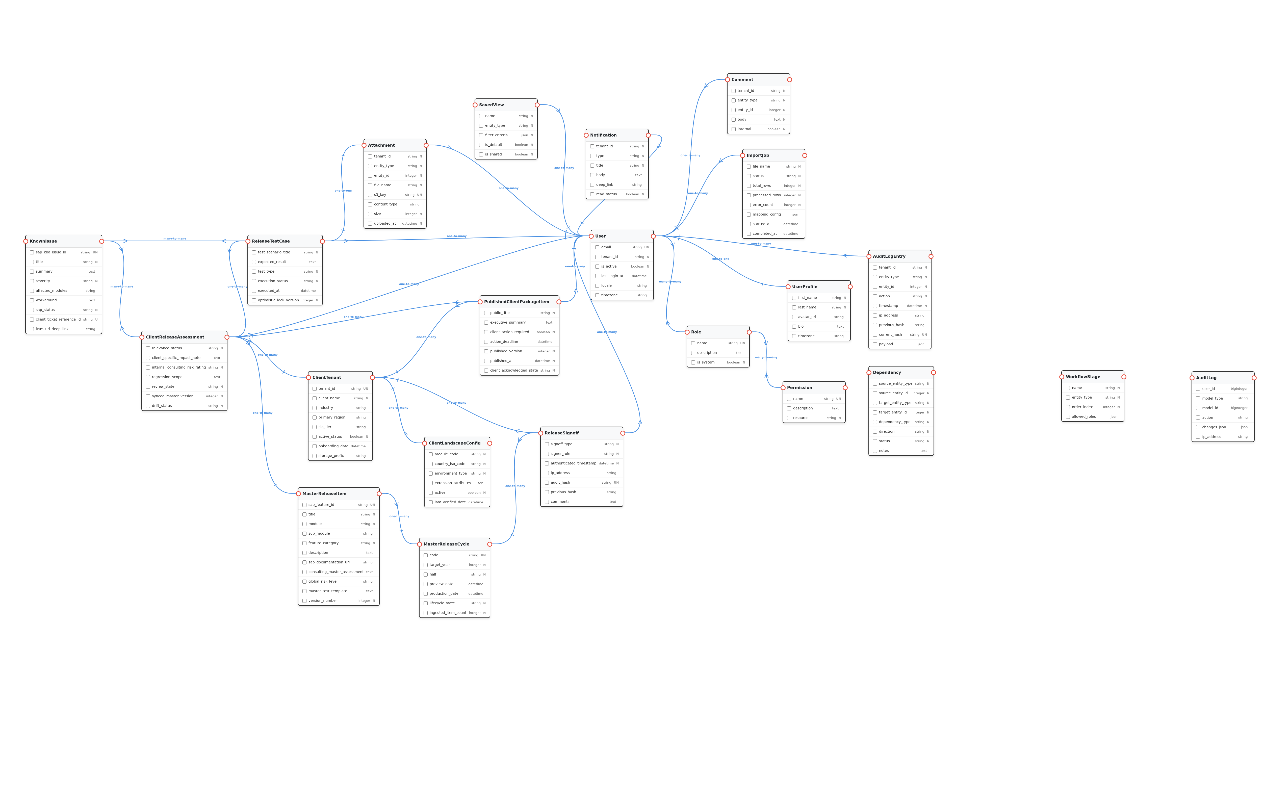
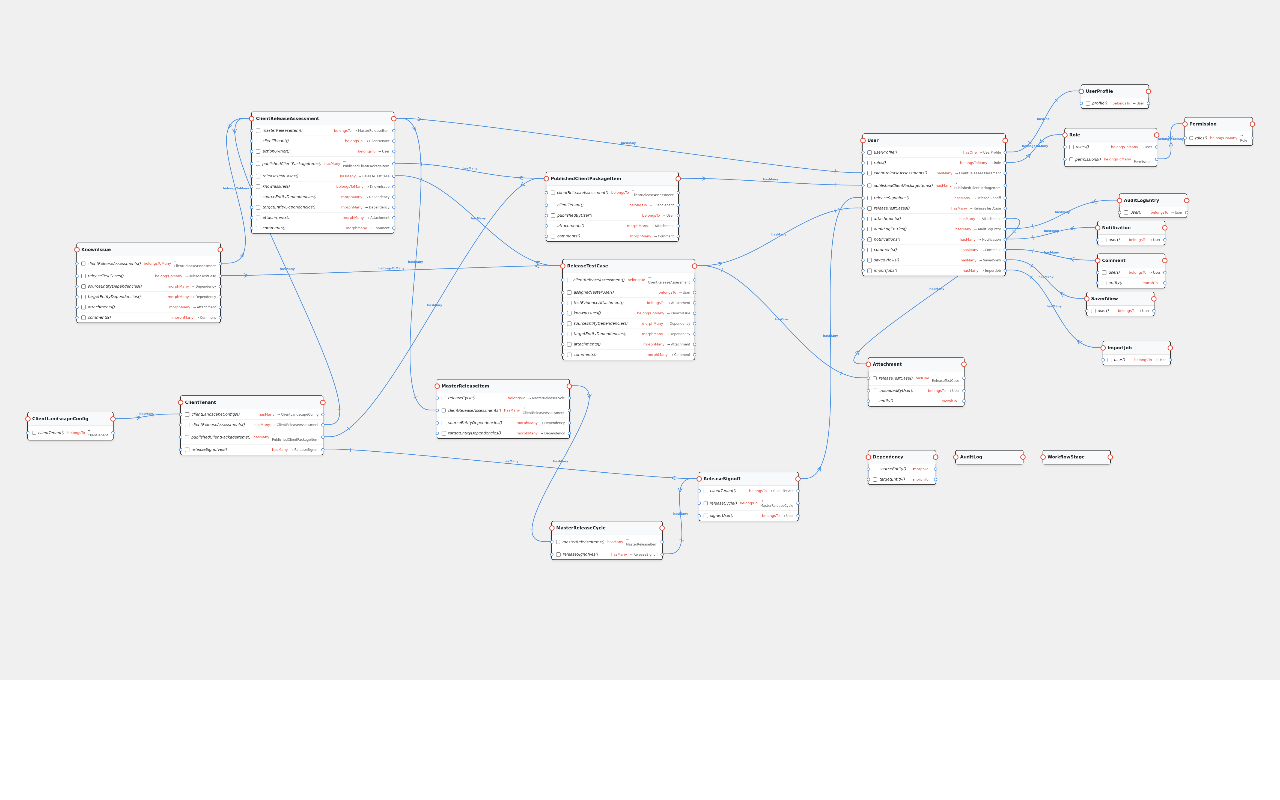
Data model
Enumerates all entities and their fields, with emphasis on physical separation between master catalog, internal assessments, and published client items. The data model must include all entities from the needs_data board and any new entities required by the workflows (e.g., Dependency, Attachment, Audit Log, Notification, Comment). Each entity element lists key fields, data types, and relationships. The section includes decisions about indexing, soft delete, timestamps, and versioning. It also surfaces risks around cross-tenant leakage and stale landscape profiles. The data model is the foundation for the permissions model and business rules; completeness is mandatory.
interpretation
critical

The data model must physically separate Master Release Catalog Items, Internal Client Assessment Overrides, and Client Published Items to enforce confidentiality.

Confirmed in claim_data_001.

interpretation

All persisted entities carry created_at and updated_at timestamps; soft-deleted entities also carry deleted_at; historical records are immutable with optimistic locking and version snapshots.

Confirmed in claim_data_002.

interpretation
critical

Entity: Master Release Cycle (ID, Code, Target Year, Half, Preview Date, Production Date, Lifecycle State, Ingested Item Count).

From needs_data core_objects.

interpretation
critical

Entity: Master Release Item (ID, Release Cycle ID, SAP Feature ID, Title, Module, Sub-Module, Feature Category, Description, SAP Documentation URL, Consulting Master Assessment RichText, Global Risk Level, Master Test Template, Version Number).

From needs_data core_objects.

interpretation
critical

Entity: Client Tenant & Profile (Tenant ID, Client Name, Industry, Primary Region, SLA Tier, Active Status, Onboarding Date, Storage Prefix).

From needs_data core_objects.

interpretation

Entity: Client Landscape Config (ID, Client Tenant ID, Module Code, Country ISO Code, Environment Type, JSONB Extension Attributes, Active Boolean, Last Verified Date).

From needs_data core_objects.

interpretation
critical

Entity: Client Release Assessment (ID, Client Tenant ID, Master Release Item ID, Relevance Status, Client-Specific Impact Note, Internal Consulting Risk Rating, Regression Scope, Action Owner ID, Review State, Synced Master Version, Drift Status).

From needs_data core_objects.

interpretation
critical

Entity: Published Client Package Item (ID, Client Release Assessment ID, Client Tenant ID, Public Title, Executive Summary, Client Action Required, Action Deadline, Published Version, Published At, Published By User ID, Client Acknowledged State).

From needs_data core_objects.

interpretation

Entity: Release Sign-off & Acknowledgment (ID, Client Tenant ID, Release Cycle ID, Sign-off Type, Signer User ID, Signer Role, Authenticated Timestamp, IP Address, Audit Hash, Previous Hash, Comments).

From needs_data core_objects.

interpretation

Entity: Known Issue & Incident Link (ID, SAP KBA/Issue ID, Title, Summary, Severity, Affected Modules, Workaround RichText, SAP Status, Client Ticket Reference ID, ITSM URL Deep Link).

From needs_data core_objects.

interpretation

Entity: Release Test Case (ID, Client Release Assessment ID, Test Scenario Title, Expected Result, Test Type, Assigned Tester User ID, Execution Status, Test Evidence Attachment ID, Executed At, Optimistic Lock Version).

From needs_data core_objects.

interpretation

Entity: Dependency (ID, Source Entity Type, Source Entity ID, Target Entity Type, Target Entity ID, Dependency Type, Direction, Status, Notes).

User accepted first-class Dependency entity for critical dependencies; informational dependencies use tags.

interpretation

Entity: Attachment (ID, Tenant ID, Entity Type, Entity ID, File Name, S3 Key, Content Type, Size, Uploaded By, Uploaded At).

Required for uploads & storage; S3 tenant-scoped prefixes confirmed.

interpretation

Entity: Audit Log Entry (ID, Tenant ID, Entity Type, Entity ID, Action, User ID, Timestamp, IP Address, Previous Hash, Current Hash, Payload).

Required for immutable audit trail; hash chaining confirmed.

interpretation

Entity: Notification (ID, Tenant ID, User ID, Type, Title, Body, Deep Link, Read Status, Created At).

Required for in-app notifications.

interpretation

Entity: Comment (ID, Tenant ID, Entity Type, Entity ID, User ID, Body, Internal Boolean, Created At, Updated At).

Required for comments on assessments and client items; internal flag for separation.

Business rules
Defines machine-checkable rules, validation criteria, scoring rules, and lifecycle gates that the system must enforce. Each rule is expressed as a clear assertion that can be implemented in code or database constraints. The section includes confirmed rules from prior boards (publication gate, tenant isolation, immutable audit, universal feature mandate, sign-off pre-requisite, optimistic concurrency) and new rules derived from the workflows (e.g., relevance classification thresholds, bypass rules, acknowledgment SLA). It also surfaces tradeoffs between strict governance and release speed, and decisions about rule configurability. Business rules are critical for ensuring data integrity and compliance; they must be unambiguous and testable.
interpretation

Universal SAP release items cannot be marked as Auto-Excluded unless the client does not own the parent module.

Confirmed in needs_data business_rules.

interpretation

Production Sign-off cannot transition to 'Approved' while any associated High/Critical Test Case remains in 'Failed' or 'Blocked' state without an approved override.

Confirmed in needs_data business_rules.

interpretation
critical

Tenant Isolation Enforcement: All SELECT, UPDATE, DELETE queries on client workspaces MUST evaluate PostgreSQL RLS policy `tenant_id = current_setting('app.current_tenant_id')`.

Confirmed in needs_data business_rules.

interpretation

Immutable Audit Requirement: Records in `release_sign_offs` and `audit_log_entries` are append-only; hard DELETE and UPDATE operations are prohibited by PostgreSQL database triggers.

Confirmed in needs_data business_rules.

interpretation

Optimistic Concurrency Lock: When saving test executions or assessment edits (via Web or Excel re-import), if `updated_at` on DB > submitted `base_version_timestamp`, reject write and open visual diff reconciliation.

Confirmed in needs_data business_rules.

decision

Bypass rule: low-risk items can skip formal sign-off with a single reviewer approval; high/critical items require full gates. All bypasses are audit-logged, and thresholds are tenant-configurable.

Confirmed in dec_sol_004.

decision

Relevance classification thresholds: Auto-Applicable if item module and country match client profile; Auto-Excluded if module not owned; Manual Review Needed if partial match or custom attributes present.

User accepted strict matching with manual review for partial matches.

decision

Acknowledgment SLA: Client Acknowledgment must be completed within N business days of publication; default N=5, configurable per client.

User accepted default 5 business days, configurable per client.

risk

Risk: Bypass thresholds may be abused if not properly audited. Mitigation: all bypasses require a second reviewer approval for medium-risk items, and all bypasses are immutable in audit log.

User accepted second reviewer for medium-risk bypasses as a governance safeguard.

tradeoff

Tradeoff: Strict validation rules vs. rapid triage. Too many required fields slow consultants; too few risk incomplete assessments. Recommended: staged validation with mandatory fields only before publication.

From project_brief risks (assessment validation).

risk

Risk: Strict matching may produce false negatives if client landscape profile is incomplete or outdated. Mitigation: periodic landscape verification and manual override with audit.

Follow-up to accepted relevance classification thresholds.

decision

What happens when Client Acknowledgment SLA is breached? Proposal: automatic escalation to Change Manager and Release Manager with real-time alert.

Follow-up to accepted SLA decision; ensures timely response.

interpretation

BR-XXX: Before creating a Known Issue or linking a support ticket, the system must check for existing records with matching SAP KBA/Issue ID or Client Ticket Reference ID and block duplicates with a link to the existing record.

User explicitly requested this business rule to address missing requirement from original prompt.

Permissions / access model
Specifies what each role can do at the row, field, and action level, based on RBAC, row-level security, and field-level security. The section includes the confirmed RLS policy and the architectural separation between internal and client-facing entities. It also includes decisions about authentication methods (email/password, SSO, MFA) and client self-service user management, which are out-of-scope by default but may be critical. The permissions model must ensure that internal consulting notes are never visible to client users, and that client users can only see published content relevant to their tenant. The section surfaces risks around permission misconfiguration and data leakage, and includes tradeoffs between granularity and administrative overhead.
interpretation
critical

The platform must implement PostgreSQL Row-Level Security (RLS) with tenant_id = current_setting('app.current_tenant_id') on all client workspace queries.

Confirmed in dec_001 and needs_data business_rules.

interpretation

Field-level security must restrict internal notes and client-visible information based on role, with separate entities for internal and published content.

Confirmed in original prompt and design principles.

decision
critical

Authentication for internal consultants: email/password login with mandatory MFA.

User edited and accepted mandatory MFA; standard secure default for consulting team.

decision
critical

Authentication for client users: SSO (OIDC/SAML) with passwordless magic link fallback.

User accepted SSO with magic link fallback as the right default for client-facing portals.

interpretation

Role-based permission matrix: Platform Administrator has full access; Release Manager can manage release cycles and sign-offs; Module Owner can edit assessments for their module; Integration Lead can edit integration-related fields; Change Manager can publish and communicate; Tester can execute tests; Support Analyst can manage known issues; Client Administrator can manage client-side users and acknowledge; Client Viewer read-only.

Derived from role descriptions and original prompt.

decision

Should field-level security be implemented via database column-level permissions or application-layer checks? Current proposal: application-layer checks with database RLS as backstop.

User accepted application-layer field-level security with database RLS as backstop.

risk
critical

Risk: Permission misconfiguration could expose internal notes to client users. Mitigation: separate entities, RLS, and automated tests for permission boundaries.

Critical risk identified in prior boards.

tradeoff

Tradeoff: Granular permissions vs. administrative overhead. Too many roles/permissions complicate management; too few risk data leakage. Recommended: preset bundles with ability to customize per tenant.

User accepted preset permission bundles with per-tenant customization.

decision
critical

Should client users be able to see other clients' published content? No, RLS enforces tenant isolation; client users only see their own tenant's published items.

Obvious but must be explicit.

decision

Which MFA method should be used for internal consultants? Proposal: TOTP authenticator apps with backup codes.

Follow-up to accepted internal authentication; standard secure MFA method.

decision

Which SSO protocols should be supported for client users? Proposal: OIDC and SAML 2.0, with OIDC preferred.

Follow-up to accepted client authentication; covers common enterprise IdPs.

decision

How should password reset be handled for internal consultants? Proposal: self-service reset via email with MFA verification.

Follow-up to confirmed internal authentication; standard pattern for password-based login.

Integrations
Describes all external system integrations, including SAP What's New import, ITSM reference IDs, SAP Support Portal deep links, S3 storage, email notifications, and any proposed authentication integrations. The section reflects the confirmed Phase 1 integration boundary (reference IDs and deep links, no bidirectional sync) and the deferred Phase 2 REST/webhook connectors. It also includes decisions about attachment storage and pre-signed URLs. The integrations section must be consistent with the data model and business rules, and it must surface risks around SAP schema mutation and external API changes.
interpretation

Phase 1 ITSM and SAP Support Portal integration uses structured Reference IDs, URL deep links, and ticket status badges, deferring bidirectional REST/webhook sync.

Confirmed in claim_003 and dec_003.

interpretation

The platform stores attachments in tenant-scoped S3 bucket prefixes with 15-minute expiring pre-signed URLs.

Confirmed in dec_001 and data_dependencies.

interpretation

SAP What's New import uses official XLSX/CSV exports with visual column mapping and header pre-flight validation.

Confirmed in claim_002.

interpretation

Email notifications are sent via a transactional email service (e.g., SES, SendGrid) with deep links to relevant items.

User accepted transactional email service with deep links as standard and sufficient.

decision

Should the platform integrate with a specific ITSM tool (ServiceNow, Jira) via API in Phase 1, or rely solely on reference IDs? Current proposal: reference IDs only, with API integration deferred.

Confirmed Phase 1 boundary.

risk

Risk: SAP What's New schema mutation may break ingestion. Mitigation: visual column mapping and header validation, with manual fallback.

Confirmed risk in data_risks.

decision

Which transactional email service should be used? Proposal: Amazon SES or SendGrid.

Follow-up to accepted email notification integration; needs selection for implementation.

risk

Risk: Email deliverability may suffer during release crunch due to high volume. Mitigation: dedicated sending domain, bounce monitoring, and in-app notification fallback.

Follow-up to accepted email notification strategy; addresses operational risk.

Non-functional requirements
Specifies performance, security, scalability, availability, compliance, internationalization, timezone, and responsive design requirements. The section includes confirmed requirements like peak concurrent usage, timezone-aware storage, and multi-language readiness. It also includes new requirements derived from the scope hints (e.g., faceted filters, full-text search, saved views, REST API) and risks around performance degradation during release crunch. Non-functional requirements are often overlooked but critical for a multi-tenant SaaS; this section ensures they are captured and measurable.
interpretation

The platform must support peak concurrent usage of 50+ consultants performing simultaneous bulk updates and imports during release crunch windows.

Confirmed in usage_context performance risk.

interpretation

The platform must provide timezone-aware storage and display for all user-facing timestamps, with locale formats and multi-language UI readiness.

Original prompt mentions multilingual content and responsive mobile-friendly interface; scope hints include timezone handling and locale formats.

interpretation

The platform must provide responsive layout for mobile and tablet, especially for client acknowledgment and executive dashboards.

Scope hints include responsive layout; original prompt mentions mobile-friendly.

interpretation

The platform must provide faceted filters, saved searches/views, and full-text search with acceptable response times (<2 seconds for typical queries).

User accepted sub-2-second response for typical queries as a reasonable performance target.

interpretation

The platform must provide a REST API with consistent error responses and rate limiting to prevent abuse.

User accepted REST API with rate limiting and consistent errors as confirmed.

risk

Risk: Database performance may degrade with large JSONB fields and complex queries. Mitigation: index foreign keys and frequently filtered columns; consider partial indexes.

User accepted indexing foreign keys and frequently filtered columns as standard mitigation.

interpretation

The platform must provide audit logging for all state changes and sign-offs, with append-only storage and hash chaining.

Confirmed in dec_004.

decision

Which full-text search technology should be used? Proposal: PostgreSQL full-text search with trigram indexes for Phase 1.

Follow-up to accepted search performance target; balances simplicity and performance.

Acceptance criteria
Defines observable, testable acceptance criteria for key features, expressed in Given/When/Then format. Each criterion must be traceable to a functional requirement or workflow step. The section includes criteria for ingestion, relevance classification, publication gate, sign-off, audit trail, bulk operations, and dashboards. It also includes criteria for non-functional aspects like performance and security. Acceptance criteria are the basis for QA and user acceptance testing; they must be specific enough to be automated or manually verified without ambiguity.
interpretation

Given a valid SAP What's New XLSX file, when the Release Manager completes the visual mapping wizard, then all rows are ingested as Master Release Items with correct field assignments and duplicate detection.

Derived from confirmed ingestion strategy.

interpretation

Given a client landscape profile with enabled modules and countries, when a new release item is ingested, then the system auto-classifies it as Auto-Applicable, Auto-Excluded, or Manual Review Needed within 30 seconds.

Derived from confirmed relevance engine.

interpretation

Given a Client Release Assessment with Relevance Status 'Applicable', non-empty Client-Facing Summary, and categorized Internal Risk, when the Change Manager attempts to publish, then the item is published to the client portal and an audit log entry is created.

Derived from publication gate.

interpretation

Given a client user with appropriate role, when they click 'Acknowledge' on a published release, then the system records their identity, timestamp, IP address, and role in an immutable audit trail with SHA-256 hash chaining.

Derived from sign-off and audit requirements.

interpretation

Given a High/Critical Test Case in 'Failed' or 'Blocked' state, when a user attempts to approve Production Sign-off, then the system blocks the approval unless an approved override is recorded.

Derived from sign-off pre-requisite gate.

interpretation

Given a bulk update action on a list view, when the user selects multiple items and applies a change, then all selected items are updated and an audit log entry is created for each.

User accepted bulk update with per-item audit log entries as correct.

interpretation

Given a dashboard view, when the user selects a client and release cycle, then the system displays Client Acknowledgment Rate, Test Execution Rate, Overdue Actions, Unresolved Dependencies, Release Readiness, and Client Acknowledgment SLA within 3 seconds.

User accepted dashboard KPIs within 3 seconds as a reasonable target.

interpretation

Given an Excel export of assessments, when the user re-imports the file after offline edits, then the system detects conflicts via optimistic concurrency and presents a visual diff merge for resolution.

Derived from offline Excel workflow.

interpretation

Given a known issue linked to a release item, when the Support Analyst updates the SAP status, then the change is reflected in the known issues register and associated client views (if published).

User accepted known issue status propagation to published client views as correct.

interpretation

Given a user with a non-English locale, when they view client-facing content, then the UI and content are displayed in their selected language (if translation exists) with correct locale formats and timezone.

User accepted multi-language display with locale and timezone as confirmed.

decision

How often should dashboard KPIs refresh? Proposal: near real-time (max 5-minute lag) with manual refresh option.

Follow-up to accepted dashboard performance target; balances freshness and load.

interpretation

Given a user attempts to create a Known Issue or link a support ticket with a duplicate SAP KBA/Issue ID or Client Ticket Reference ID, the system blocks the action and provides a link to the existing record.

User explicitly requested this acceptance criterion for duplicate prevention.

Out of scope
Explicitly lists features and capabilities that are NOT part of this product, mirroring what was rejected in earlier boards. This section prevents scope creep and ensures that the team does not inadvertently build excluded functionality. It includes items like automated test execution, full ITSM replacement, SAP deployment, LMS hosting, multi-ERP support, and direct SAP credential storage. It also includes out-of-scope capabilities from the scope hints (e.g., onboarding, navigation, design system, theming, keyboard navigation, screen reader support, SMS/push notifications, etc.) unless they are proposed as critical via _feature_tag_proposal elements. The out-of-scope list is a contract; any change requires a formal decision.
interpretation
critical

The platform does not execute automated UI/API regression tests against SAP tenants; it only manages test plans, cases, and sign-offs.

Explicitly excluded in scope_boundaries.

interpretation

The platform is not a full ITSM replacement; it links to ServiceNow/Jira tickets via reference IDs and deep links only.

Explicitly excluded in scope_boundaries.

interpretation
critical

The platform does not deploy MDF XML or Provisioning settings into SAP; it governs the decision to deploy and tracks checklist completion.

Explicitly excluded in scope_boundaries.

interpretation

The platform does not host custom LMS video content; it links out to existing learning management systems or secure cloud storage.

Explicitly excluded in scope_boundaries.

interpretation

The platform does not support other ERP ecosystems (Workday, Oracle Cloud HCM) in Phase 1.

Explicitly excluded in scope_boundaries.

interpretation

The platform does not store SAP S-User passwords, Provisioning credentials, or API secret keys.

Explicitly excluded in scope_boundaries.

interpretation

Out-of-scope capabilities from scope hints: Onboarding, Navigation, Empty & error states, Design system, Theming, Keyboard navigation, Contrast & typography, Screen reader support, SMS notifications, Push notifications, Policy-based access (ABAC), GDPR controls, Rate limiting & abuse prevention, CRUD screens, SLAs & escalations, Validation rules, Auto-derivations, Scheduled reports, Webhooks, Third-party connectors, Job queue, Scheduled jobs, Live updates (WebSockets/SSE), Collaboration & presence, Modular boundaries, API contracts, Caching strategy, Latency targets (p95/p99), DB optimization, Timeouts & retries, Graceful degradation, Logs, metrics, traces, SLOs & alerting, Automated testing (unit/integration/e2e), CI/CD pipelines, Feature flags & staged rollout.

These are explicitly out of scope by default per the scope hints; they are not included unless proposed as critical via _feature_tag_proposal.

decision

Should any of the out-of-scope capabilities be reconsidered as critical? If so, propose via _feature_tag_proposal. Currently, only authentication (email/password, SSO) is proposed as critical.

User accepted no further out-of-scope capability proposals beyond authentication.

Remaining assumptions
Captures every claim that is not yet confirmed but is being relied upon for the specification. This section is honest about uncertainty and highlights areas where the user must provide input before the spec can be finalized. Assumptions include authentication method, client self-service, notification strategy, translation strategy, hypercare duration, dependency modeling, and any other unresolved decisions. Each assumption is marked as proposed with a confidence level and a suggested answer if applicable. The assumptions section feeds directly into the readiness blockers; unresolved high-priority assumptions prevent the spec from reaching readiness above 0.6.
interpretation

Authentication method confirmed: email/password + MFA for internal consultants; SSO (OIDC/SAML) with passwordless magic link fallback for client users.

User edited and accepted this assumption as confirmed.

interpretation

Client self-service user management: consulting admin provisioning in Phase 1; client self-service deferred to Phase 2.

User edited and accepted this assumption as confirmed.

interpretation

Notification strategy confirmed: hybrid — daily/weekly batched email digests plus real-time urgent alerts.

User edited and accepted this assumption as confirmed.

interpretation

Multilingual translation strategy: AI-assisted machine draft with human review before publishing.

User accepted AI-assisted machine draft with human review as reasonable.

interpretation

The operating model board (workflow_roles and swimlane) is empty in the provided context; we assume it is not yet available and proceed with the confirmed claims from other boards.

User accepted proceeding without the operating model board; spec is coherent from other confirmed claims.

interpretation

The platform will use PostgreSQL as the primary database, with S3 for attachments, and a transactional email service for notifications.

User accepted PostgreSQL + S3 + transactional email as reasonable stack assumption.

interpretation

The platform will implement rate limiting and consistent error responses for the REST API, even though these are out-of-scope by default, because they are standard for public-ish endpoints.

User accepted rate limiting and consistent errors for REST API as standard practice.

decision

Should we create an operating model board before finalizing the spec? Proposal: defer to after spec lock-in; current spec is coherent without it.

Follow-up to accepted assumption about empty operating model board.

Workflow / Roles
Sandbox
Swimlane workflow
Sandbox
Specification

SAP SuccessFactors Release and Change Governance — Specification

Product overview

A consulting-first, multi-tenant SaaS platform for SAP SuccessFactors release governance. It ingests semi-annual SAP What's New data, auto-matches release items against per-client landscape profiles, supports internal triage and assessment, publishes tailored client-facing packages, and tracks acknowledgment, testing, sign-off, and hypercare through an immutable audit trail.

Problem statement

Consulting firms and MSPs managing multiple SAP SuccessFactors clients face duplicated release analysis, risk of cross-client data leakage, and lack of traceability from SAP release notes through client sign-off. Manual spreadsheet tracking is chaotic, error-prone, and cannot provide the audit trail required for enterprise governance.

Target users & roles

  • Release Manager — Oversees release cycles, ingests SAP What's New data, coordinates final sign-off, and closes release cycles.
  • Module Owner — Functional expert who assesses module-specific impact, writes client-facing summaries, and provides regression guidance.
  • Integration Lead — Technical lead who assesses API/interface changes, integration impacts, and technical dependencies.
  • Change Manager — Owns client-facing publication and communication, ensuring client-ready summaries and deadlines.
  • Tester — Executes test cases, uploads evidence, and records pass/fail/blocked statuses.
  • Support Analyst — Tracks known issues, links incidents, confirms workarounds at sign-off, and triages hypercare incidents.
  • Client Administrator — Client-side HRIS lead who reviews, acknowledges, and signs off on releases.
  • Client Viewer — Read-only client user who can view published content and acknowledge communications.
  • Platform Administrator — Manages tenant configuration, user roles, and system settings.

User journeys

Release Ingestion to Client Publication

  1. Release Manager uploads SAP What's New XLSX/CSV file via the Ingestion Wizard.
  2. Release Manager maps columns visually and validates headers; system detects duplicates and creates Master Release Items.
  3. System auto-classifies each Master Release Item against each Client Landscape Profile, producing Auto-Applicable, Auto-Excluded, or Manual Review Needed.
  4. Module Owners and Integration Leads review auto-classified items, add internal notes, risk ratings, and regression guidance.
  5. Change Manager selects assessments, writes client-facing summaries, sets deadlines, and publishes to client portal.

Client Acknowledgment to Production Sign-off

  1. Client Administrator reviews published items in the client portal.
  2. Client Administrator acknowledges the release (bulk with per-item exceptions for high-impact items).
  3. Testers execute test cases linked to release items, upload evidence, and record results.
  4. Client Administrator and Release Manager complete formal production sign-off with authenticated confirmation.
  5. Support Analyst triages incidents during Hypercare & Closure and links SAP cases.

Functional requirements

FR-001: SAP What's New Ingestion Wizard

The system shall provide an XLSX/CSV Import Wizard with visual column mapping, header validation, automated duplicate detection, and manual line-item entry fallback. This serves the confirmed ingestion strategy (dec_002) and ensures resilient ingestion immune to SAP portal redesigns.

Acceptance criteria:

  • Given a valid SAP What's New XLSX file, when the Release Manager completes the visual mapping wizard, then all rows are ingested as Master Release Items with correct field assignments and duplicate detection.

FR-002: Automated Relevance Classification

The system shall auto-classify release items against client landscape profiles using a hybrid relational/JSONB matching engine, producing Auto-Applicable, Auto-Excluded, or Manual Review Needed states. This serves the confirmed relevance engine (claim_data_003) and reduces manual triage effort.

Acceptance criteria:

  • Given a client landscape profile with enabled modules and countries, when a new release item is ingested, then the system auto-classifies it as Auto-Applicable, Auto-Excluded, or Manual Review Needed within 30 seconds.

FR-003: Publication Gate

The system shall enforce a publication gate: a Client Release Assessment cannot be published unless Relevance Status is 'Applicable', Client-Facing Summary is non-empty, and Internal Risk is categorized. This serves the confirmed business rule (claim_spec_013) preventing premature or unreviewed technical records from leaking to clients.

Acceptance criteria:

  • Given a Client Release Assessment with Relevance Status 'Applicable', non-empty Client-Facing Summary, and categorized Internal Risk, when the Change Manager attempts to publish, then the item is published to the client portal and an audit log entry is created.

FR-004: Immutable Audit Logging

The system shall provide immutable audit logging with SHA-256 hash chaining for all sign-offs and publication events, capturing user identity, timestamp, IP address, and role. This serves the confirmed audit mechanism (dec_004) providing non-repudiation for enterprise compliance.

Acceptance criteria:

  • Given a client user with appropriate role, when they click 'Acknowledge' on a published release, then the system records their identity, timestamp, IP address, and role in an immutable audit trail with SHA-256 hash chaining.

FR-005: Bulk Operations and Excel Import/Export

The system shall support bulk updates, Excel import/export for offline assessment and testing plans, and optimistic concurrency with visual diff merge. This serves the confirmed offline capabilities (claim_spec_015) and concurrency strategy (claim_data_002).

Acceptance criteria:

  • Given an Excel export of assessments, when the user re-imports the file after offline edits, then the system detects conflicts via optimistic concurrency and presents a visual diff merge for resolution.

FR-006: Search, Filters, and Saved Views

The system shall provide faceted filters, saved searches/views, and full-text search across release items, assessments, and known issues. This serves the confirmed search and filter requirements from the original prompt and scope hints.

Acceptance criteria:

  • Given a user on the Release Catalog screen, when they apply a faceted filter for module and country, then the list updates to show only matching items within 2 seconds.

FR-007: Dashboards and KPIs

The system shall provide dashboards and KPIs including Client Acknowledgment Rate, Test Execution Rate, Overdue Actions, Unresolved Dependencies, Release Readiness, and Client Acknowledgment SLA. This serves the confirmed KPI set (dec_new_kpis).

Acceptance criteria:

  • Given a dashboard view, when the user selects a client and release cycle, then the system displays all six KPIs within 3 seconds.

FR-008: Notifications

The system shall provide configurable email notifications and in-app notifications, with daily/weekly batched digests and real-time urgent alerts. This serves the confirmed hybrid notification strategy (claim_spec_033).

Acceptance criteria:

  • Given a user with notification preferences set to daily digest, when a new release item is published, then the user receives a daily digest email with deep links to relevant items.

FR-009: Multi-language and Timezone Support

The system shall provide multi-language UI support with locale formats and timezone handling for all user-facing timestamps. This serves the confirmed multilingual requirement (claim_spec_026) and scope hints.

Acceptance criteria:

  • Given a user with a non-English locale, when they view client-facing content, then the UI and content are displayed in their selected language with correct locale formats and timezone.

FR-010: Responsive Mobile Interface

The system shall provide a responsive, mobile-friendly interface for client acknowledgment and executive dashboards. This serves the confirmed mobile requirement from the original prompt.

Acceptance criteria:

  • Given a client user on a mobile device, when they access the client portal, then the acknowledgment interface and executive dashboard are usable without horizontal scrolling.

FR-011: REST API

The system shall provide a REST API for all major entities, with consistent error responses and rate limiting. This serves the confirmed REST API requirement (claim_spec_108) and standard pattern for public-ish endpoints.

Acceptance criteria:

  • Given an authenticated API client, when they request a list of release items, then the response is JSON with consistent error format and rate limit headers.

FR-012: Forms and Validation UX

The system shall provide forms with validation UX, including required fields, regex validation for SAP case IDs, and date constraints. This serves the confirmed validation requirements from needs_data user_inputs.

Acceptance criteria:

  • Given a user entering a SAP Case Reference ID, when the input does not match the regex ^[0-9]{10}$, then the form displays a validation error and blocks submission.

FR-013: Task Completion Tracking

The system shall provide task completion tracking with owners, deadlines, and status history for every workflow stage. This serves the confirmed task completion requirement (claim_spec_044) and original prompt.

Acceptance criteria:

  • Given a release item with an assigned owner and deadline, when the owner completes the assessment, then the status history records the completion with timestamp and user identity.

FR-014: Known Issue Register and Duplicate Prevention

The system shall provide a Known Issues register where users can link records to SAP Known Issues, associate issues with releases, clients, modules, environments, support tickets, workarounds, and regression tests. Before creating a Known Issue or linking a support ticket, the system must check for existing records with matching SAP KBA/Issue ID or Client Ticket Reference ID and block duplicates with a link to the existing record. This serves the confirmed duplicate prevention business rule (claim_spec_041).

Acceptance criteria:

  • Given a user attempts to create a Known Issue with a duplicate SAP KBA/Issue ID, when they submit the form, then the system blocks the action and provides a link to the existing record.

FR-015: Master Catalog Drift Detection and Merge

The system shall flag downstream client assessments as 'Update Available' when a master release item is updated, and provide a three-way diff merge interface for consultants to review and accept or reject changes. This serves the confirmed drift detection (claim_data_004) and synchronization strategy (dec_data_001).

Acceptance criteria:

  • Given a master release item is updated after syndication, when a consultant views a downstream client assessment, then the system displays an 'Update Available' badge and a three-way diff merge interface.

Screen / page inventory

  • Consulting Dashboard — Shows release cycles, triage progress, overdue actions, and KPIs for the consulting team.
    • Elements: Release cycle list with status, Triage progress bar, Overdue actions widget, KPI cards (Acknowledgment Rate, Test Execution Rate, etc.)
  • Release Catalog — Lists master release items with filters, search, saved views, and bulk operations.
    • Elements: Faceted filter panel, Full-text search bar, Saved views dropdown, Bulk action toolbar
  • Ingestion Wizard — Multi-step wizard for XLSX/CSV upload, column mapping, validation, and duplicate detection.
    • Elements: File upload dropzone, Visual column mapping interface, Header validation preview, Duplicate detection results
  • Client Landscape Profile — Form for configuring modules, countries, sub-features, and integration endpoints for a client.
    • Elements: Module multi-select, Country ISO code picker, JSONB extension attributes editor, Integration endpoint list
  • Assessment Triage Queue — List of client release assessments with relevance status, risk, owner, and drift indicators.
    • Elements: Assessment list with filters, Relevance status badges, Risk rating indicators, Drift status badges
  • Assessment Detail — Form for internal notes, risk rating, regression scope, and relevance override.
    • Elements: Internal notes rich text editor, Risk rating selector, Regression scope text area, Relevance override dropdown
  • Publication Builder — Interface for Change Manager to select assessments, write client-facing summaries, set deadlines, and publish to client portal.
    • Elements: Assessment selection list, Client-facing summary editor, Action deadline picker, Publish button with gate validation
  • Client Portal Dashboard — Shows published release items, action items, and acknowledgment status for client users.
    • Elements: Published items list, Action items widget, Acknowledgment status indicators, Executive summary cards
  • Client Release Detail — Progressive disclosure view with executive summary, action required, deadline, and drill-down for technical details.
    • Elements: Executive summary section, Action required and deadline, Drill-down toggle for technical details, Acknowledgment button
  • Client Acknowledgment — Bulk acknowledgment interface with optional per-item exceptions and audit capture.
    • Elements: Bulk acknowledgment button, Per-item exception checkboxes, Audit confirmation dialog, Acknowledgment status list
  • Test Plan & Execution — List of test cases with execution status, evidence upload, and pass/fail/blocked recording.
    • Elements: Test case list, Execution status selector, Evidence upload button, Pass/fail/blocked recording interface
  • Sign-off — Formal sign-off interface with checkbox confirmation, legal acknowledgment, and digital identity confirmation.
    • Elements: Checkbox confirmation, Legal acknowledgment statement, Digital identity confirmation (MFA re-auth), Sign-off note field
  • Known Issues Register — List of known issues with SAP KBA links, workarounds, affected clients, and support ticket references.
    • Elements: Known issue list with filters, SAP KBA link column, Workaround text display, Support ticket reference column
  • Reports & Exports — Interface for generating executive PDF/Excel dossiers and management reports.
    • Elements: Report type selector, Client and release filters, PDF export button, Excel export button
  • Admin & RBAC — Interface for managing users, roles, permissions, and tenant settings.
    • Elements: User management table, Role assignment dropdown, Permission bundle editor, Tenant settings form
  • Notifications Center — In-app notification list with deep links to relevant items.
    • Elements: Notification list, Read/unread indicators, Deep link buttons, Notification preferences

Data model

MasterReleaseCycle

Field Type Notes
id uuid Primary key, unique
code string e.g. '1H 2025', unique, indexed
target_year integer Year of release
half enum(1H,2H) Half of the year
preview_date datetime Preview release date
production_date datetime Production release date
lifecycle_state enum(Draft,ActiveTriage,Published,HistoricalReadOnly) Current lifecycle state
ingested_item_count integer Number of items ingested
created_at datetime Creation timestamp
updated_at datetime Last update timestamp

MasterReleaseItem

Field Type Notes
id uuid Primary key, unique
release_cycle_id foreign_key->MasterReleaseCycle FK to MasterReleaseCycle, indexed
sap_feature_id string SAP feature ID, indexed
title string Title of the release item
module string Module name, indexed
sub_module string Sub-module name
feature_category enum(Universal,AdminOptIn,Deprecation) Feature category
description text Description of the release item
sap_documentation_url string URL to SAP documentation
consulting_master_assessment text Rich text master assessment
global_risk_level enum(Low,Med,High,Critical) Global risk level
master_test_template text Master test template
version_number integer Version number for optimistic locking
created_at datetime Creation timestamp
updated_at datetime Last update timestamp

ClientTenant

Field Type Notes
id uuid Primary key, unique
tenant_id string Tenant identifier for RLS, unique, indexed
client_name string Client name
industry string Industry
primary_region string Primary region
sla_tier string SLA tier
active_status boolean Active status
onboarding_date datetime Onboarding date
storage_prefix string S3 storage prefix
created_at datetime Creation timestamp
updated_at datetime Last update timestamp

ClientLandscapeConfig

Field Type Notes
id uuid Primary key, unique
client_tenant_id foreign_key->ClientTenant FK to ClientTenant, indexed
module_code string Module code, indexed
country_iso_code string ISO-3166 alpha-2 country code, indexed
environment_type enum(Preview,Test,Prod) Environment type
extension_attributes jsonb JSONB for sub-features, custom MDF objects, integration endpoints
active boolean Active flag
last_verified_date datetime Last verified date
created_at datetime Creation timestamp
updated_at datetime Last update timestamp

ClientReleaseAssessment

Field Type Notes
id uuid Primary key, unique
client_tenant_id foreign_key->ClientTenant FK to ClientTenant, indexed
master_release_item_id foreign_key->MasterReleaseItem FK to MasterReleaseItem, indexed
relevance_status enum(AutoExcluded,UnderReview,Applicable,Defer) Relevance status
client_specific_impact_note text Client-specific impact note
internal_consulting_risk_rating enum(Low,Med,High,Critical) Internal risk rating
regression_scope text Regression scope
action_owner_id foreign_key->User FK to User, indexed
review_state enum(Draft,InAssessment,Complete) Review state
synced_master_version integer Synced master version
drift_status enum(InSync,UpdateAvailable) Drift status
created_at datetime Creation timestamp
updated_at datetime Last update timestamp

PublishedClientPackageItem

Field Type Notes
id uuid Primary key, unique
client_release_assessment_id foreign_key->ClientReleaseAssessment FK to ClientReleaseAssessment, indexed
client_tenant_id foreign_key->ClientTenant FK to ClientTenant, indexed
public_title string Public title
executive_summary text Executive summary
client_action_required boolean Action required flag
action_deadline datetime Action deadline
published_version integer Published version
published_at datetime Published timestamp
published_by_user_id foreign_key->User FK to User, indexed
client_acknowledged_state enum(Pending,Acknowledged,Exceptions) Acknowledgment state
created_at datetime Creation timestamp
updated_at datetime Last update timestamp

ReleaseSignoff

Field Type Notes
id uuid Primary key, unique
client_tenant_id foreign_key->ClientTenant FK to ClientTenant, indexed
release_cycle_id foreign_key->MasterReleaseCycle FK to MasterReleaseCycle, indexed
signoff_type enum(PreviewTestingAcknowledged,ProductionGoLiveApproved) Sign-off type
signer_user_id foreign_key->User FK to User, indexed
signer_role string Signer role
authenticated_timestamp datetime Authenticated timestamp
ip_address string IP address
audit_hash string SHA-256 audit hash
previous_hash string Previous hash in chain
comments text Comments
created_at datetime Creation timestamp

KnownIssue

Field Type Notes
id uuid Primary key, unique
sap_kba_issue_id string SAP KBA/Issue ID, unique, indexed
title string Title
summary text Summary
severity enum(P1,P2,P3,P4) Severity
affected_modules string Affected modules
workaround text Workaround rich text
sap_status enum(Investigating,FixInPreview,Resolved) SAP status
client_ticket_reference_id string Client ticket reference ID, indexed
itsm_url_deep_link string ITSM URL deep link
created_at datetime Creation timestamp
updated_at datetime Last update timestamp

ReleaseTestCase

Field Type Notes
id uuid Primary key, unique
client_release_assessment_id foreign_key->ClientReleaseAssessment FK to ClientReleaseAssessment, indexed
test_scenario_title string Test scenario title
expected_result text Expected result
test_type enum(Smoke,Regression,Integration) Test type
assigned_tester_user_id foreign_key->User FK to User, indexed
execution_status enum(NotStarted,Passed,Failed,Blocked) Execution status
test_evidence_attachment_id foreign_key->Attachment FK to Attachment
executed_at datetime Executed timestamp
optimistic_lock_version integer Optimistic lock version
created_at datetime Creation timestamp
updated_at datetime Last update timestamp

Dependency

Field Type Notes
id uuid Primary key, unique
source_entity_type enum(MasterReleaseItem,ClientReleaseAssessment,ReleaseTestCase,KnownIssue) Source entity type
source_entity_id uuid Source entity ID
target_entity_type enum(MasterReleaseItem,ClientReleaseAssessment,ReleaseTestCase,KnownIssue) Target entity type
target_entity_id uuid Target entity ID
dependency_type enum(Blocks,IsBlockedBy,RelatedTo) Dependency type
direction enum(Forward,Backward) Direction
status enum(Open,Resolved) Status
notes text Notes
created_at datetime Creation timestamp
updated_at datetime Last update timestamp

Attachment

Field Type Notes
id uuid Primary key, unique
tenant_id string Tenant ID for RLS, indexed
entity_type enum(ClientReleaseAssessment,ReleaseTestCase,KnownIssue,PublishedClientPackageItem) Entity type
entity_id uuid Entity ID
file_name string File name
s3_key string S3 key
content_type string Content type
size integer File size in bytes
uploaded_by_user_id foreign_key->User FK to User, indexed
uploaded_at datetime Upload timestamp
created_at datetime Creation timestamp

AuditLogEntry

Field Type Notes
id uuid Primary key, unique
tenant_id string Tenant ID for RLS, indexed
entity_type string Entity type
entity_id uuid Entity ID
action string Action performed
user_id foreign_key->User FK to User, indexed
timestamp datetime Timestamp
ip_address string IP address
previous_hash string Previous hash in chain
current_hash string Current hash
payload jsonb Payload
created_at datetime Creation timestamp

Notification

Field Type Notes
id uuid Primary key, unique
tenant_id string Tenant ID for RLS, indexed
user_id foreign_key->User FK to User, indexed
type enum(Email,InApp) Notification type
title string Title
body text Body
deep_link string Deep link
read_status boolean Read status
created_at datetime Creation timestamp

Comment

Field Type Notes
id uuid Primary key, unique
tenant_id string Tenant ID for RLS, indexed
entity_type enum(ClientReleaseAssessment,PublishedClientPackageItem,KnownIssue,ReleaseTestCase) Entity type
entity_id uuid Entity ID
user_id foreign_key->User FK to User, indexed
body text Comment body
internal boolean Internal flag for separation
created_at datetime Creation timestamp
updated_at datetime Last update timestamp

User

Field Type Notes
id uuid Primary key, unique
tenant_id string Tenant ID for RLS, indexed
email string Email, unique, indexed
role enum(PlatformAdministrator,ReleaseManager,ModuleOwner,IntegrationLead,ChangeManager,Tester,SupportAnalyst,ClientAdministrator,ClientViewer) User role
created_at datetime Creation timestamp
updated_at datetime Last update timestamp

Business rules

  • Publication Gate: A Client Release Assessment cannot be published unless Relevance Status is 'Applicable', Client-Facing Summary is non-empty, and Internal Risk is categorized.
  • Tenant Isolation Enforcement: All SELECT, UPDATE, DELETE queries on client workspaces MUST evaluate PostgreSQL RLS policy tenant_id = current_setting('app.current_tenant_id').
  • Immutable Audit Requirement: Records in release_sign_offs and audit_log_entries are append-only; hard DELETE and UPDATE operations are prohibited by PostgreSQL database triggers.
  • Universal Feature Mandate: Any SAP Release Item flagged as 'Universal' by SAP cannot be marked as 'Auto-Excluded' unless the client does not own the parent module.
  • Sign-off Pre-requisite Gate: Client Production Sign-off cannot transition to 'Approved' while any associated High/Critical Test Case remains in 'Failed' or 'Blocked' state without an approved override.
  • Optimistic Concurrency Lock: When saving test executions or assessment edits (via Web or Excel re-import), if updated_at on DB > submitted base_version_timestamp, reject write and open visual diff reconciliation.
  • Duplicate Issue Prevention: Before creating a Known Issue or linking a support ticket, the system must check for existing records with matching SAP KBA/Issue ID or Client Ticket Reference ID and block duplicates with a link to the existing record.

Permissions

Role Capabilities
Platform Administrator create, read, update, delete all entities; manage users and roles; configure tenant settings
Release Manager create, read, update MasterReleaseCycle and MasterReleaseItem; read all assessments; change_stage to Published; coordinate sign-off
Module Owner read MasterReleaseItem; create, read, update ClientReleaseAssessment for their module; write internal notes and risk ratings
Integration Lead read MasterReleaseItem; create, read, update ClientReleaseAssessment for integration-related fields; write technical dependencies
Change Manager read ClientReleaseAssessment; create, read, update PublishedClientPackageItem; publish to client portal; communicate with clients
Tester read ReleaseTestCase; update execution status; upload evidence
Support Analyst create, read, update KnownIssue; link incidents; confirm workarounds at sign-off; triage hypercare incidents
Client Administrator read PublishedClientPackageItem; acknowledge releases; assign actions to client users; sign off on production
Client Viewer read PublishedClientPackageItem; acknowledge communications

Integrations

  • SAP What's New XLSX/CSV import via visual mapping wizard
  • ITSM reference IDs and deep links (ServiceNow, Jira)
  • SAP Support Portal deep links
  • S3 storage for attachments with tenant-scoped prefixes and pre-signed URLs
  • Transactional email service (SES or SendGrid)

Non-functional requirements

  • Performance: Support peak concurrent usage of 50+ consultants performing simultaneous bulk updates and imports during release crunch windows.
  • Security: Implement PostgreSQL Row-Level Security (RLS) with tenant_id = current_setting('app.current_tenant_id') on all client workspace queries.
  • Scalability: Support semi-annual release cycles with compressed 4-6 week crunch windows.
  • Internationalization: Provide timezone-aware storage and display for all user-facing timestamps, with locale formats and multi-language UI readiness.
  • Responsive Design: Provide responsive layout for mobile and tablet, especially for client acknowledgment and executive dashboards.
  • Search Performance: Provide faceted filters, saved searches/views, and full-text search with acceptable response times (<2 seconds for typical queries).

Edge cases

  • User imports CSV with 50,000 rows — system must process within 30 minutes and provide progress feedback.
  • Two consultants edit the same assessment simultaneously — system must detect conflict via optimistic concurrency and present visual diff merge.
  • Client landscape profile is stale (module added mid-year) — system must flag potential false negatives and prompt landscape verification.
  • SAP What's New schema changes between releases — system must handle via visual column mapping and header validation with manual fallback.
  • Client acknowledgment SLA is breached — system must trigger automatic escalation to Change Manager and Release Manager with real-time alert.
  • Duplicate Known Issue creation attempted — system must block and provide link to existing record.

Out of scope

  • Automated test execution against SAP tenants
  • Full ITSM replacement
  • SAP transport/package deployment
  • Custom LMS video hosting
  • Multi-ERP support (Workday, Oracle Cloud HCM)
  • Direct SAP tenant credential storage
  • Onboarding, Navigation, Empty & error states, Design system, Theming, Keyboard navigation, Contrast & typography, Screen reader support, SMS notifications, Push notifications, Policy-based access (ABAC), GDPR controls, Rate limiting & abuse prevention, CRUD screens, SLAs & escalations, Validation rules, Auto-derivations, Scheduled reports, Webhooks, Third-party connectors, Job queue, Scheduled jobs, Live updates (WebSockets/SSE), Collaboration & presence, Modular boundaries, API contracts, Caching strategy, Latency targets (p95/p99), DB optimization, Timeouts & retries, Graceful degradation, Logs, metrics, traces, SLOs & alerting, Automated testing (unit/integration/e2e), CI/CD pipelines, Feature flags & staged rollout

Assumptions & open items

Assumed:

  • Hypercare duration is configurable per release with a default of 2 weeks, overridable per client.
  • Dependency modeling uses hybrid approach: first-class entity for critical dependencies, tags for informational.
  • Bypass threshold granularity uses global defaults with client-level overrides, all changes audit-logged.
  • Offline Excel conflict resolution: importing user resolves with visual diff, release manager can override.
  • Executive vs technical field classification: impact summary, action required, deadline = executive; regression scope, test cases, technical notes = drill-down.
  • High-impact items are flagged for per-item acknowledgment automatically based on Internal Risk rating (High/Critical) with manual override by Change Manager.
  • Real-time urgent alerts are triggered by SLA breaches, failed sign-off gates, high-impact publication events, and overdue actions.
  • MFA method for internal consultants is TOTP authenticator apps with backup codes.
  • SSO protocols for client users support OIDC and SAML 2.0, with OIDC preferred.
  • Password reset for internal consultants is self-service via email with MFA verification.
  • Transactional email service is Amazon SES or SendGrid.
  • Full-text search technology is PostgreSQL full-text search with trigram indexes for Phase 1.
  • Dashboard KPIs refresh near real-time (max 5-minute lag) with manual refresh option.
  • Operating model board creation is deferred until after spec lock-in.
  • Client Acknowledgment SLA default is 5 business days, configurable per client.
  • Relevance classification thresholds: Auto-Applicable if item module and country match client profile; Auto-Excluded if module not owned; Manual Review Needed if partial match or custom attributes present.

Coverage notes

  • Functional requirements: 15 (with acceptance criteria: 15)
  • Open assumptions: 16 (unresolved/conflicted: 0)
  • Entities in data model: 15
  • Screens: 16, Roles: 9, Journeys: 2
Screen map
Sandbox
Entities diagram
Sandbox
DB schema
Sandbox
Data models
Sandbox
Entities & DB (text)

Entity-relationship model for SAP SuccessFactors Release and Change Governance. Includes base User + UserProfile, RBAC entities, and the domain entities required by the specification for release ingestion, assessment, publication, sign-off, testing, known issues, audit, notifications, and attachments.

Entities (22)
User

Application user identity for authentication and authorization. Includes both consulting team members and client users.

  • email string
    unique

    Unique email address used for login.

  • tenant_id string

    Tenant identifier for row-level security.

  • is_active boolean

    Whether the user account is active.

  • last_login_at datetime
    nullable

    Timestamp of the user's last login.

  • locale string
    nullable

    Preferred locale for UI and content display.

  • timezone string
    nullable

    IANA timezone identifier for local time display.

UserProfile

Extended profile information for a user.

  • first_name string

    User's first name.

  • last_name string

    User's last name.

  • avatar_url string
    nullable

    URL to the user's avatar image.

  • bio text
    nullable

    Short biography or professional summary.

  • timezone string
    nullable

    IANA timezone identifier.

Role

Named role for role-based access control (RBAC).

  • name string
    unique

    Unique role name (e.g., Release Manager, Client Administrator).

  • description text
    nullable

    Description of the role's responsibilities.

  • is_system boolean

    Whether this is a built-in system role.

Permission

Granular permission that can be granted to roles.

  • name string
    unique

    Unique permission name (e.g., publish_assessment).

  • description text
    nullable

    Description of what the permission allows.

  • resource string

    Resource or entity this permission applies to.

MasterReleaseCycle

Represents a semi-annual SAP release cycle (e.g., 1H 2025).

  • code string
    unique

    Unique release cycle code (e.g., '1H 2025').

  • target_year integer

    Target year of the release.

  • half string

    Half of the year (1H or 2H).

  • preview_date datetime
    nullable

    Preview release date.

  • production_date datetime
    nullable

    Production release date.

  • lifecycle_state string

    Current lifecycle state.

  • ingested_item_count integer

    Number of items ingested in this cycle.

MasterReleaseItem

A single SAP What's New release item ingested from SAP documentation.

  • sap_feature_id string
    unique

    SAP feature ID, indexed for duplicate detection.

  • title string

    Title of the release item.

  • module string

    Module name (e.g., Employee Central).

  • sub_module string
    nullable

    Sub-module name.

  • feature_category string

    Feature category.

  • description text
    nullable

    Full description of the release item.

  • sap_documentation_url string
    nullable

    URL to SAP documentation.

  • consulting_master_assessment text
    nullable

    Rich text master assessment by consulting team.

  • global_risk_level string
    nullable

    Global risk level.

  • master_test_template text
    nullable

    Master test template for this item.

  • version_number integer

    Version number for optimistic locking.

ClientTenant

Represents a client organization (tenant) managed by the consulting firm.

  • tenant_id string
    unique

    Unique tenant identifier for row-level security.

  • client_name string

    Display name of the client.

  • industry string
    nullable

    Industry vertical of the client.

  • primary_region string
    nullable

    Primary geographic region.

  • sla_tier string
    nullable

    Service level agreement tier.

  • active_status boolean

    Whether the client is active.

  • onboarding_date datetime
    nullable

    Date the client was onboarded.

  • storage_prefix string
    nullable

    S3 storage prefix for tenant-scoped files.

ClientLandscapeConfig

Configuration of modules, countries, and integration endpoints for a client landscape.

  • module_code string

    Module code (e.g., EC, PMGM).

  • country_iso_code string

    ISO-3166 alpha-2 country code.

  • environment_type string

    Environment type.

  • extension_attributes json
    nullable

    JSONB for sub-features, custom MDF objects, integration endpoints.

  • active boolean

    Whether this landscape config is active.

  • last_verified_date datetime
    nullable

    Date the landscape was last verified.

ClientReleaseAssessment

Client-specific assessment of a master release item, including relevance classification and risk rating.

  • relevance_status string

    Relevance status.

  • client_specific_impact_note text
    nullable

    Client-specific impact note.

  • internal_consulting_risk_rating string

    Internal risk rating.

  • regression_scope text
    nullable

    Regression scope for testing.

  • review_state string

    Review state.

  • synced_master_version integer

    Version of the master item this assessment was synced from.

  • drift_status string

    Drift status.

PublishedClientPackageItem

A client-facing published package item derived from a client release assessment.

  • public_title string

    Client-facing title.

  • executive_summary text
    nullable

    Executive summary for client stakeholders.

  • client_action_required boolean

    Whether client action is required.

  • action_deadline datetime
    nullable

    Deadline for client action.

  • published_version integer

    Published version number.

  • published_at datetime

    Timestamp when published.

  • client_acknowledged_state string

    Acknowledgment state.

ReleaseSignoff

Formal sign-off record for a release cycle, with immutable audit hash chaining.

  • signoff_type string

    Sign-off type.

  • signer_role string

    Role of the signer at time of signing.

  • authenticated_timestamp datetime

    Timestamp of authenticated sign-off.

  • ip_address string
    nullable

    IP address of the signer.

  • audit_hash string
    unique

    SHA-256 audit hash for this sign-off.

  • previous_hash string
    nullable

    Previous hash in the audit chain.

  • comments text
    nullable

    Sign-off comments or notes.

KnownIssue

Register of SAP known issues and client-specific incidents.

  • sap_kba_issue_id string
    unique

    SAP KBA/Issue ID, unique for duplicate prevention.

  • title string

    Title of the known issue.

  • summary text
    nullable

    Summary of the issue.

  • severity string

    Severity.

  • affected_modules string
    nullable

    Modules affected by this issue.

  • workaround text
    nullable

    Workaround rich text.

  • sap_status string

    SAP status.

  • client_ticket_reference_id string
    unique
    nullable

    Client ticket reference ID for duplicate prevention.

  • itsm_url_deep_link string
    nullable

    ITSM URL deep link.

ReleaseTestCase

Test case linked to a client release assessment for execution tracking.

  • test_scenario_title string

    Title of the test scenario.

  • expected_result text
    nullable

    Expected result of the test.

  • test_type string

    Test type.

  • execution_status string

    Execution status.

  • executed_at datetime
    nullable

    Timestamp when the test was executed.

  • optimistic_lock_version integer

    Optimistic lock version for concurrency control.

Dependency

Represents a dependency between release items, assessments, test cases, or known issues.

  • source_entity_type string

    Polymorphic source entity type.

  • source_entity_id integer

    Polymorphic source entity ID.

  • target_entity_type string

    Polymorphic target entity type.

  • target_entity_id integer

    Polymorphic target entity ID.

  • dependency_type string

    Dependency type.

  • direction string

    Direction.

  • status string

    Status.

  • notes text
    nullable

    Notes about the dependency.

Attachment

File attachment with tenant-scoped storage and polymorphic parent reference.

  • tenant_id string

    Tenant ID for row-level security.

  • entity_type string

    Polymorphic parent entity type.

  • entity_id integer

    Polymorphic parent entity ID.

  • file_name string

    Original file name.

  • s3_key string
    unique

    S3 storage key.

  • content_type string
    nullable

    MIME content type.

  • size integer

    File size in bytes.

  • uploaded_at datetime

    Timestamp when uploaded.

AuditLogEntry

Immutable audit trail entry with hash chaining for sensitive actions.

  • tenant_id string

    Tenant ID for row-level security.

  • entity_type string

    Entity type that was acted upon.

  • entity_id integer

    Entity ID that was acted upon.

  • action string

    Action performed (e.g., publish, signoff, acknowledge).

  • timestamp datetime

    Timestamp of the action.

  • ip_address string
    nullable

    IP address of the actor.

  • previous_hash string
    nullable

    Previous hash in the audit chain.

  • current_hash string
    unique

    Current hash for this entry.

  • payload json
    nullable

    JSON payload with details of the action.

Notification

In-app or email notification sent to a user.

  • tenant_id string

    Tenant ID for row-level security.

  • type string

    Notification type.

  • title string

    Notification title.

  • body text
    nullable

    Notification body.

  • deep_link string
    nullable

    Deep link to the relevant item.

  • read_status boolean

    Whether the notification has been read.

Comment

Comment on a polymorphic parent entity, with internal/external flag.

  • tenant_id string

    Tenant ID for row-level security.

  • entity_type string

    Polymorphic parent entity type.

  • entity_id integer

    Polymorphic parent entity ID.

  • body text

    Comment body.

  • internal boolean

    Whether the comment is internal-only.

SavedView

Saved filter preset or view configuration for a user or role.

  • name string

    Name of the saved view.

  • entity_type string

    Entity type this view applies to.

  • filter_criteria json

    JSON filter criteria.

  • is_default boolean

    Whether this is the default view for the user/role.

  • is_shared boolean

    Whether this view is shared with others.

WorkflowStage

Defines a stage in a multi-step workflow for release governance.

  • name string

    Stage name (e.g., Triage, Assessment, Publication).

  • entity_type string

    Entity type this stage applies to.

  • order_index integer

    Order of the stage in the workflow.

  • allowed_roles json
    nullable

    Roles allowed to act at this stage.

ImportJob

Tracks an import job (XLSX/CSV) for release item ingestion.

  • file_name string

    Original file name.

  • status string

    Status of the import job.

  • total_rows integer

    Total number of rows in the file.

  • processed_rows integer

    Number of rows processed.

  • error_count integer

    Number of errors encountered.

  • mapping_config json
    nullable

    Column mapping configuration.

  • started_at datetime
    nullable

    Timestamp when the import started.

  • completed_at datetime
    nullable

    Timestamp when the import completed.

AuditLog

Auto-added from feature tags.

  • user_id bigInteger
    nullable
  • model_type string
    nullable
  • model_id bigInteger
    nullable
  • action string
    nullable
  • changes_json json
    nullable
  • ip_address string
    nullable
Relationships (25)
From Type To Description
user
one-to-one
user_profile Each user has one profile with extended information.
user
many-to-many
role Users are assigned one or more roles for RBAC.
role
many-to-many
permission Roles grant one or more permissions.
master_release_cycle
one-to-many
master_release_item A release cycle contains many master release items.
client_tenant
one-to-many
client_landscape_config A client tenant has one or more landscape configurations.
master_release_item
one-to-many
client_release_assessment A master release item is assessed for many clients.
client_tenant
one-to-many
client_release_assessment A client tenant has many release assessments.
user
one-to-many
client_release_assessment A user owns many client release assessments.
client_release_assessment
one-to-many
published_client_package_item A client release assessment can be published into many package items.
client_tenant
one-to-many
published_client_package_item A client tenant has many published package items.
user
one-to-many
published_client_package_item A user publishes many client package items.
client_tenant
one-to-many
release_signoff A client tenant has many sign-off records.
master_release_cycle
one-to-many
release_signoff A release cycle has many sign-off records.
user
one-to-many
release_signoff A user signs many release sign-offs.
client_release_assessment
one-to-many
release_test_case A client release assessment has many test cases.
user
one-to-many
release_test_case A user is assigned many test cases.
attachment
one-to-one
release_test_case A test case may have one evidence attachment.
user
one-to-many
attachment A user uploads many attachments.
user
one-to-many
audit_log_entry A user performs many audited actions.
user
one-to-many
notification A user receives many notifications.
user
one-to-many
comment A user writes many comments.
user
one-to-many
saved_view A user creates many saved views.
user
one-to-many
import_job A user initiates many import jobs.
known_issue
many-to-many
client_release_assessment Known issues can be linked to many client release assessments.
known_issue
many-to-many
release_test_case Known issues can be linked to many test cases.
Database tables (26)
users
  • id bigInteger
    unique
  • email string
    unique
  • tenant_id string
  • is_active boolean
  • last_login_at datetime
    nullable
  • locale string
    nullable
  • timezone string
    nullable
  • created_at timestamp
    nullable
  • updated_at timestamp
    nullable
user_profiles
  • id bigInteger
    unique
  • first_name string
  • last_name string
  • avatar_url string
    nullable
  • bio text
    nullable
  • timezone string
    nullable
  • profile_id bigInteger
    unique
  • created_at timestamp
    nullable
  • updated_at timestamp
    nullable
roles
  • id bigInteger
    unique
  • name string
    unique
  • description text
    nullable
  • is_system boolean
  • created_at timestamp
    nullable
  • updated_at timestamp
    nullable
permissions
  • id bigInteger
    unique
  • name string
    unique
  • description text
    nullable
  • resource string
  • created_at timestamp
    nullable
  • updated_at timestamp
    nullable
master_release_cycles
  • id bigInteger
    unique
  • code string
    unique
  • target_year integer
  • half string
  • preview_date datetime
    nullable
  • production_date datetime
    nullable
  • lifecycle_state string
  • ingested_item_count integer
  • created_at timestamp
    nullable
  • updated_at timestamp
    nullable
master_release_items
  • id bigInteger
    unique
  • sap_feature_id string
    unique
  • title string
  • module string
  • sub_module string
    nullable
  • feature_category string
  • description text
    nullable
  • sap_documentation_url string
    nullable
  • consulting_master_assessment text
    nullable
  • global_risk_level string
    nullable
  • master_test_template text
    nullable
  • version_number integer
  • release_cycle_id bigInteger
    nullable
  • created_at timestamp
    nullable
  • updated_at timestamp
    nullable
client_tenants
  • id bigInteger
    unique
  • tenant_id string
    unique
  • client_name string
  • industry string
    nullable
  • primary_region string
    nullable
  • sla_tier string
    nullable
  • active_status boolean
  • onboarding_date datetime
    nullable
  • storage_prefix string
    nullable
  • created_at timestamp
    nullable
  • updated_at timestamp
    nullable
client_landscape_configs
  • id bigInteger
    unique
  • module_code string
  • country_iso_code string
  • environment_type string
  • extension_attributes json
    nullable
  • active boolean
  • last_verified_date datetime
    nullable
  • client_tenant_id bigInteger
    nullable
  • created_at timestamp
    nullable
  • updated_at timestamp
    nullable
client_release_assessments
  • id bigInteger
    unique
  • relevance_status string
  • client_specific_impact_note text
    nullable
  • internal_consulting_risk_rating string
  • regression_scope text
    nullable
  • review_state string
  • synced_master_version integer
  • drift_status string
  • master_release_item_id bigInteger
    nullable
  • client_tenant_id bigInteger
    nullable
  • action_owner_id bigInteger
    nullable
  • created_at timestamp
    nullable
  • updated_at timestamp
    nullable
published_client_package_items
  • id bigInteger
    unique
  • public_title string
  • executive_summary text
    nullable
  • client_action_required boolean
  • action_deadline datetime
    nullable
  • published_version integer
  • published_at datetime
  • client_acknowledged_state string
  • client_release_assessment_id bigInteger
    nullable
  • client_tenant_id bigInteger
    nullable
  • published_by_user_id bigInteger
    nullable
  • created_at timestamp
    nullable
  • updated_at timestamp
    nullable
release_signoffs
  • id bigInteger
    unique
  • signoff_type string
  • signer_role string
  • authenticated_timestamp datetime
  • ip_address string
    nullable
  • audit_hash string
    unique
  • previous_hash string
    nullable
  • comments text
    nullable
  • client_tenant_id bigInteger
    nullable
  • release_cycle_id bigInteger
    nullable
  • signer_user_id bigInteger
    nullable
  • created_at timestamp
    nullable
  • updated_at timestamp
    nullable
known_issues
  • id bigInteger
    unique
  • sap_kba_issue_id string
    unique
  • title string
  • summary text
    nullable
  • severity string
  • affected_modules string
    nullable
  • workaround text
    nullable
  • sap_status string
  • client_ticket_reference_id string
    unique
    nullable
  • itsm_url_deep_link string
    nullable
  • created_at timestamp
    nullable
  • updated_at timestamp
    nullable
release_test_cases
  • id bigInteger
    unique
  • test_scenario_title string
  • expected_result text
    nullable
  • test_type string
  • execution_status string
  • executed_at datetime
    nullable
  • optimistic_lock_version integer
  • client_release_assessment_id bigInteger
    nullable
  • assigned_tester_user_id bigInteger
    nullable
  • test_evidence_attachment_id bigInteger
    unique
  • created_at timestamp
    nullable
  • updated_at timestamp
    nullable
dependencies
  • id bigInteger
    unique
  • source_entity_type string
  • source_entity_id integer
  • target_entity_type string
  • target_entity_id integer
  • dependency_type string
  • direction string
  • status string
  • notes text
    nullable
  • created_at timestamp
    nullable
  • updated_at timestamp
    nullable
attachments
  • id bigInteger
    unique
  • tenant_id string
  • entity_type string
  • entity_id integer
  • file_name string
  • s3_key string
    unique
  • content_type string
    nullable
  • size integer
  • uploaded_at datetime
  • uploaded_by_user_id bigInteger
    nullable
  • created_at timestamp
    nullable
  • updated_at timestamp
    nullable
audit_log_entries
  • id bigInteger
    unique
  • tenant_id string
  • entity_type string
  • entity_id integer
  • action string
  • timestamp datetime
  • ip_address string
    nullable
  • previous_hash string
    nullable
  • current_hash string
    unique
  • payload json
    nullable
  • user_id bigInteger
    nullable
  • created_at timestamp
    nullable
  • updated_at timestamp
    nullable
notifications
  • id bigInteger
    unique
  • tenant_id string
  • type string
  • title string
  • body text
    nullable
  • deep_link string
    nullable
  • read_status boolean
  • user_id bigInteger
    nullable
  • created_at timestamp
    nullable
  • updated_at timestamp
    nullable
comments
  • id bigInteger
    unique
  • tenant_id string
  • entity_type string
  • entity_id integer
  • body text
  • internal boolean
  • user_id bigInteger
    nullable
  • created_at timestamp
    nullable
  • updated_at timestamp
    nullable
saved_views
  • id bigInteger
    unique
  • name string
  • entity_type string
  • filter_criteria json
  • is_default boolean
  • is_shared boolean
  • user_id bigInteger
    nullable
  • created_at timestamp
    nullable
  • updated_at timestamp
    nullable
workflow_stages
  • id bigInteger
    unique
  • name string
  • entity_type string
  • order_index integer
  • allowed_roles json
    nullable
  • created_at timestamp
    nullable
  • updated_at timestamp
    nullable
import_jobs
  • id bigInteger
    unique
  • file_name string
  • status string
  • total_rows integer
  • processed_rows integer
  • error_count integer
  • mapping_config json
    nullable
  • started_at datetime
    nullable
  • completed_at datetime
    nullable
  • user_id bigInteger
    nullable
  • created_at timestamp
    nullable
  • updated_at timestamp
    nullable
audit_logs
  • id bigInteger
    unique
  • user_id bigInteger
    nullable
  • model_type string
    nullable
  • model_id bigInteger
    nullable
  • action string
    nullable
  • changes_json json
    nullable
  • ip_address string
    nullable
  • created_at timestamp
    nullable
  • updated_at timestamp
    nullable
role_user
  • id bigInteger
    unique
  • user_id bigInteger
  • role_id bigInteger
  • created_at timestamp
    nullable
  • updated_at timestamp
    nullable
permission_role
  • id bigInteger
    unique
  • role_id bigInteger
  • permission_id bigInteger
  • created_at timestamp
    nullable
  • updated_at timestamp
    nullable
client_release_assessment_known_issue
  • id bigInteger
    unique
  • known_issue_id bigInteger
  • client_release_assessment_id bigInteger
  • created_at timestamp
    nullable
  • updated_at timestamp
    nullable
known_issue_release_test_cas
  • id bigInteger
    unique
  • known_issue_id bigInteger
  • release_test_cas_id bigInteger
  • created_at timestamp
    nullable
  • updated_at timestamp
    nullable