
A simpler alternative to a large-scale, secure legal operati — Specification
Product overview
A centralized workspace for legal teams, company secretaries, executives, board members, finance teams, compliance officers, and external counsel to manage legal entities, board activities, contracts, legal matters, documents, and legal spending. It includes a board portal, contract lifecycle management, legal matter management, secure document library, AI assistance, role-based dashboards, granular permissions, configurable workflows, and integrations.
Problem statement
Large-scale legal operations and corporate governance platforms are often complex, expensive, and difficult to adopt. This project aims to provide a simpler, more intuitive alternative that still covers the essential capabilities for multinational organizations, including entity management, board portal, contract lifecycle, legal matters, document library, AI assistance, and granular permissions.
Target users & roles
- Legal Ops — Legal operations professionals, company secretaries, executives, board members, finance teams, compliance officers, and external counsel who need a unified platform for corporate governance and legal management.
User journeys
Contract Approval Journey
- Legal Ops user creates a new contract using a template.
- The contract is sent for collaborative drafting to the counterparty.
- After negotiation, the contract is submitted for approval.
- The approval request is routed to the manager's queue.
- The manager approves the contract, and it moves to 'Active' status.
- The system sends a notification to the contract owner.
Functional requirements
FR-1: Legal Entity Management
The system must allow users to maintain complete records for legal entities, including subsidiaries and branches across multiple countries, and track ownership structures, directors, officers, shareholders, mandates, capital changes, registrations, beneficial owners, and statutory obligations. The system must also provide visualization of ownership structures and organizational charts. This is essential for multinational organizations to have a single source of truth for corporate governance.
Acceptance criteria:
- Given a legal entity with a filing deadline, when the current date is within 30 days of the deadline, then the system sends a notification to the responsible owner and the company secretary.
FR-2: Board Portal
The system must provide a board portal where authorized users can schedule meetings, prepare agendas, collect agenda requests, assemble and securely distribute board packs, annotate documents, hold discussions, record attendance, manage conflicts of interest, conduct votes, approve written resolutions, assign follow-up actions, generate minutes, and collect electronic signatures. This centralizes board activities and ensures secure collaboration.
Acceptance criteria:
- Given a board meeting with a scheduled start time, when the meeting start time is within 24 hours, then the system locks the board pack and prevents further edits to the agenda and documents.
FR-3: Contract Lifecycle Management
The system must provide contract lifecycle management covering request intake, template selection, collaborative drafting, clause libraries, negotiation, internal approval, signature, renewal, termination, and obligation tracking, with version comparison, related-party records, configurable approval thresholds, risk flags, and automated reminders. This reduces contract cycle time and improves compliance.
Acceptance criteria:
- Given a contract with status='Draft' and an approval threshold of $10,000, when a user submits the contract for approval, then the system creates an approval request and routes it to the approver queue of the user's manager.
FR-4: Legal Matter Management
The system must support legal matter management for litigation, claims, investigations, regulatory requests, and advisory work, with intake forms, owners, stakeholders, timelines, tasks, deadlines, budgets, external counsel, invoices, evidence, correspondence, outcomes, and links to related contracts or entities. This provides a complete view of legal work and spend.
Acceptance criteria:
- Given a legal matter with type='Litigation' and status='Open', when a user adds an invoice to the matter, then the system updates the actual spend and displays it on the matter dashboard.
FR-5: Secure Document Library
The system must include a secure document library with folders, metadata, permissions, version history, retention rules, document previews, full-text search, OCR, and controlled external sharing. This ensures that legal documents are stored securely and are easily retrievable.
Acceptance criteria:
- Given a document with a retention period of 7 years, when the retention period expires, then the system marks the document as 'Retention Expired' and prevents further edits, but retains it for audit purposes.
FR-6: AI Assistance
The system must provide AI assistance that can summarize documents and meetings, extract contract terms and obligations, identify unusual or missing clauses, translate legal content, answer questions using authorized documents, suggest tags, and generate first drafts while clearly showing source references and requiring human review. This enhances productivity while maintaining accountability.
Acceptance criteria:
- Given a document uploaded to the library, when the user requests an AI summary, then the system generates a summary with source references and displays a disclaimer that human review is required.
FR-7: Granular Permissions, Workflows, and Administration
The system must support granular permissions by legal entity, country, department, matter, contract, committee, document sensitivity, and user role, including temporary access for external advisers, segregation of duties, confidential matters, delegated approvals, and a complete immutable audit history. The system must also provide configurable workflows, notifications, escalations, comments, mentions, task assignments, approval queues, and email or in-app reminders, as well as administration settings for legal entities, jurisdictions, currencies, languages, document templates, numbering rules, approval matrices, retention periods, and notification preferences. This ensures data security and compliance.
Acceptance criteria:
- Given a user with role 'External Counsel' and temporary access to a matter, when the temporary access expires, then the system revokes all permissions for that user on the matter and logs the revocation in the audit trail.
- Given a user with role 'System Admin', when the user configures a new workflow for contract approval, then the system applies the workflow to all new contract submissions.
FR-8: Role-Based Dashboards
The system must provide role-based home pages and dashboards showing upcoming meetings, expiring contracts, overdue actions, entity compliance status, open matters, legal spend, workload, risks, and recent activity, with drill-down charts, saved views, advanced search, filters, and configurable reports. This gives users a personalized overview of their responsibilities.
Acceptance criteria:
- Given a user with role 'Legal Ops', when the user views their dashboard, then the system displays widgets for upcoming meetings, expiring contracts, overdue actions, entity compliance status, open matters, legal spend, workload, risks, and recent activity, with drill-down charts and saved views.
FR-9: Import/Export, Integrations, and Mobile Access
The system must allow bulk imports from spreadsheets, exports to Excel and PDF, scheduled reports, API-based integrations with identity providers, electronic signature services, email, calendars, finance and ERP systems, and provide responsive mobile access with secure board-pack reading, offline access, annotations, voting, approvals, and biometric login. This ensures interoperability and accessibility.
Acceptance criteria:
- Given a user with role 'Legal Ops', when the user imports a spreadsheet of legal entities, then the system validates the data and creates the entities, and reports any errors. When the user exports a report to Excel or PDF, then the system generates the file. When the user schedules a report, then the system sends it at the scheduled time. When the user accesses the system via mobile, then the system provides secure board-pack reading, offline access, annotations, voting, approvals, and biometric login.
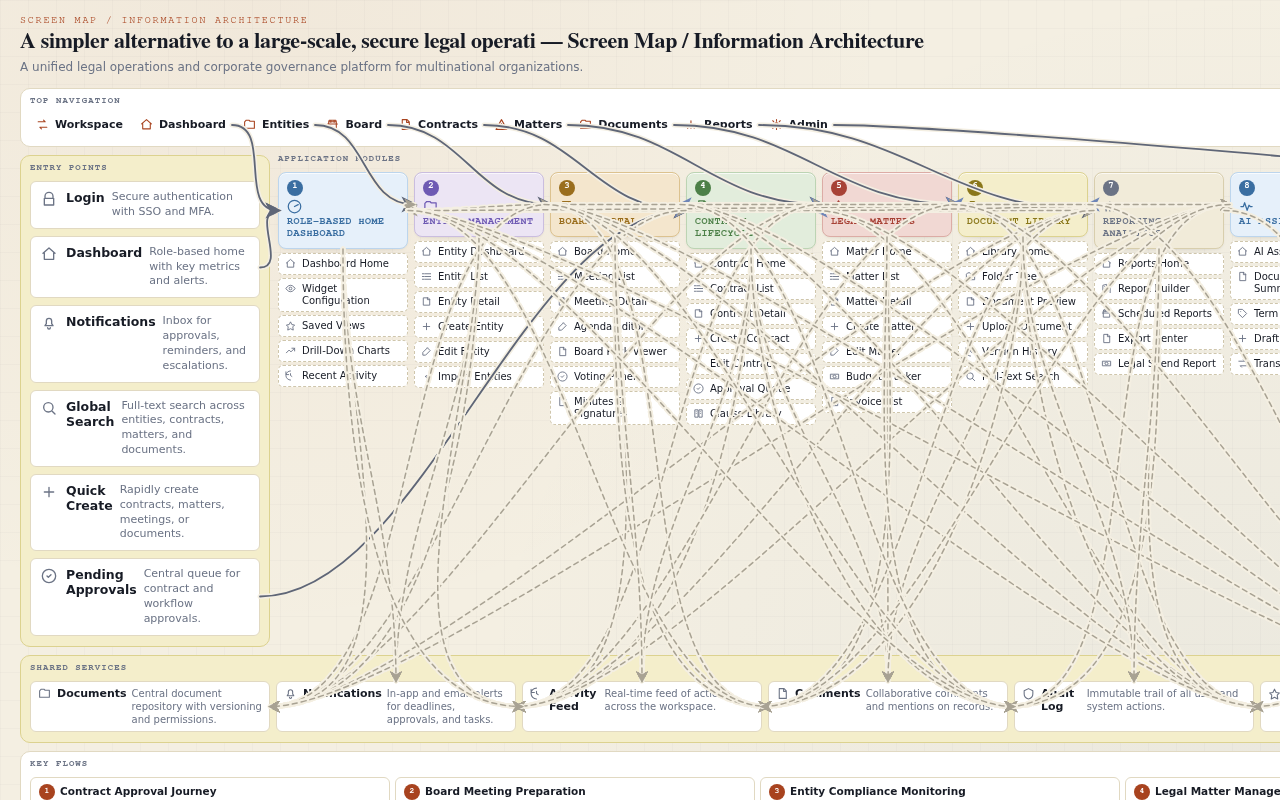
Screen / page inventory
- Entity Management Dashboard — Provides a comprehensive view of all legal entities, their ownership structures, and compliance status.
- Elements: Entity list table, Entity detail panel, Ownership chart, Statutory obligations list
- Board Portal — Allows authorized users to manage board meetings, distribute materials, and conduct votes.
- Elements: Meeting list, Agenda editor, Board pack viewer, Voting panel, Attendance list
- Contract Management — Provides a centralized view of all contracts, their status, and approval processes.
- Elements: Contract list, Contract detail view, Approval workflow panel, Renewal reminders
- Legal Matter Management — Enables tracking of legal matters, budgets, and tasks.
- Elements: Matter list, Matter detail view, Task list, Budget tracker, Invoice list
- Document Library — Provides secure storage and retrieval of legal documents.
- Elements: Document tree, Document preview, Search bar, Version history
- Role-Based Home Dashboard — Gives users a personalized overview of their responsibilities and alerts.
- Elements: Dashboard widgets, Upcoming meetings list, Expiring contracts list, Overdue tasks list, Legal spend chart
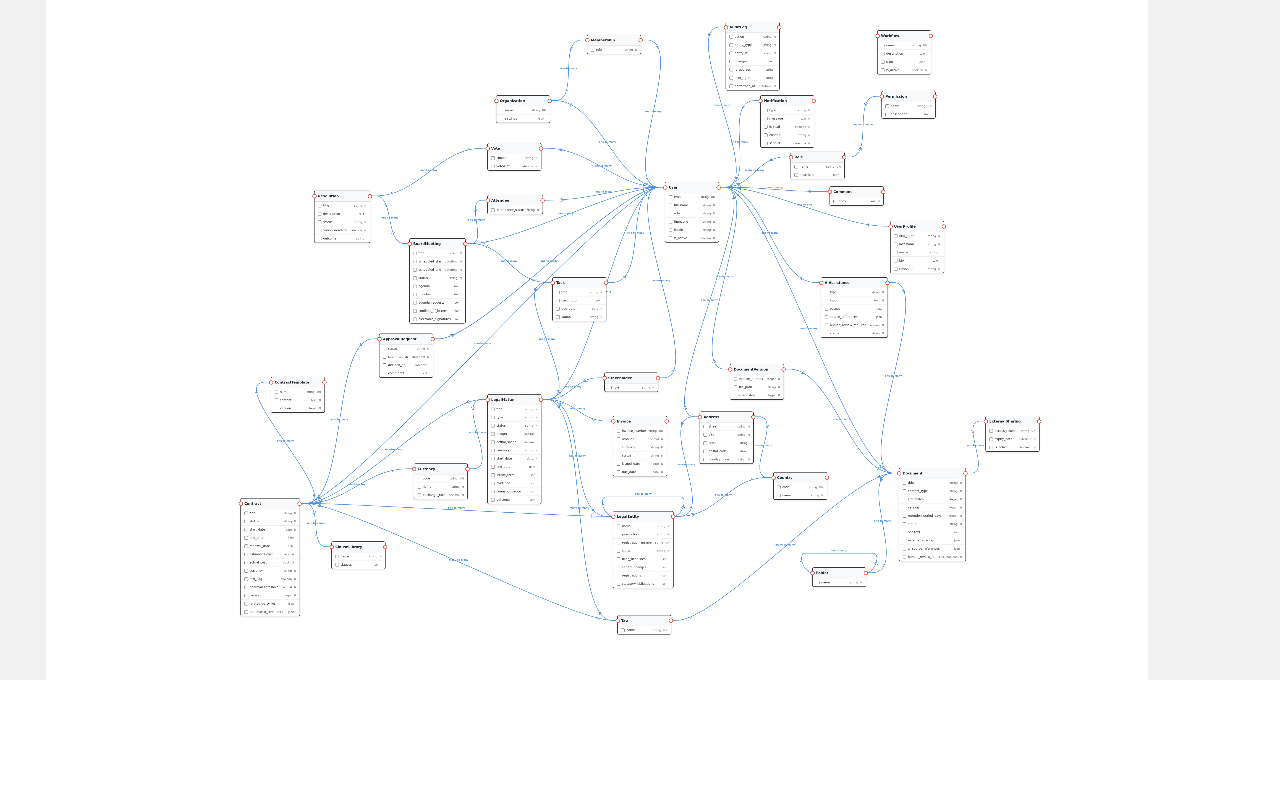
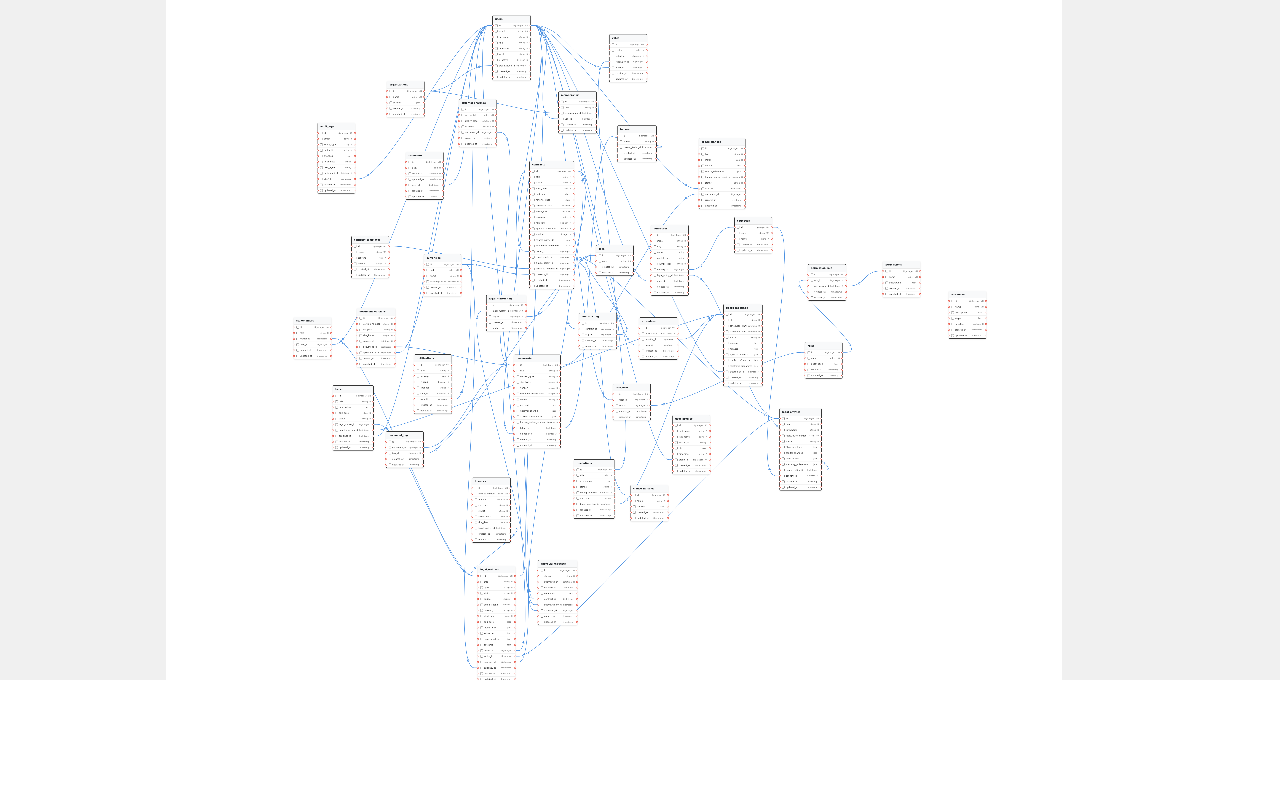
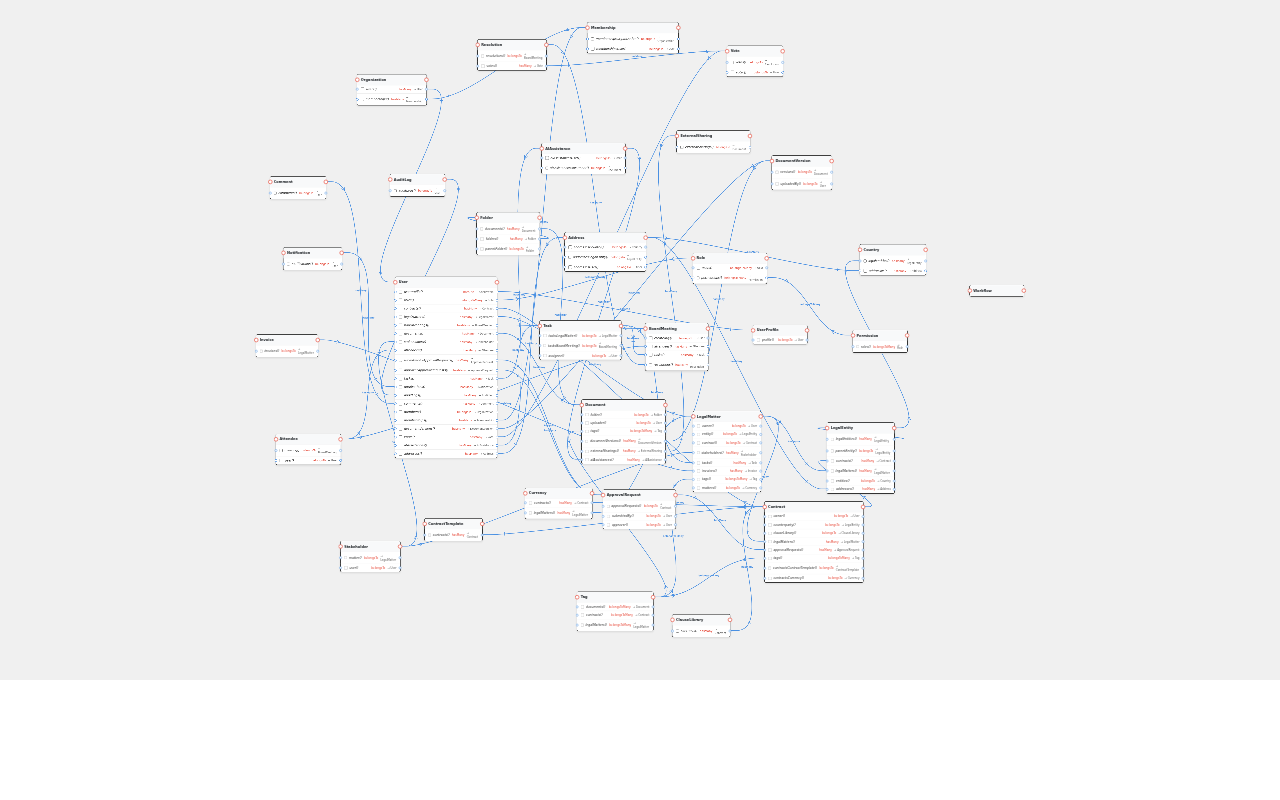
Data model
User
| Field | Type | Notes |
|---|---|---|
id |
uuid | Primary key, UUID |
email |
string | Unique, indexed, max length 255 |
full_name |
string | Max length 255 |
role |
enum(...) | Enum: System Admin, Legal Ops, Company Secretary, Executive, Board Member, Finance, Compliance, External Counsel |
timezone |
string | IANA timezone string, default UTC |
locale |
string | Language code, default en |
is_active |
boolean | Boolean, default true |
created_at |
datetime | Timestamp, default now |
updated_at |
datetime | Timestamp, auto-updated |
LegalEntity
| Field | Type | Notes |
|---|---|---|
id |
uuid | Primary key, UUID |
name |
string | Max length 255, indexed |
jurisdiction |
string | Country code, ISO 3166-1 alpha-2 |
registration_number |
string | Max length 100, unique per jurisdiction |
parent_entity_id |
foreign_key->LegalEntity | Foreign key to LegalEntity, nullable for top-level |
status |
enum(...) | Enum: Active, Inactive, Pending, Dissolved |
filing_deadlines |
json | JSON array of {obligation, deadline, responsible_party} |
capital_changes |
json | JSON array of {date, type, amount, currency} |
registrations |
json | JSON array of {authority, registration_number, expiry_date} |
statutory_obligations |
json | JSON array of {obligation, frequency, next_due_date} |
created_at |
datetime | Timestamp, default now |
updated_at |
datetime | Timestamp, auto-updated |
Contract
| Field | Type | Notes |
|---|---|---|
id |
uuid | Primary key, UUID |
title |
string | Max length 255 |
status |
enum(...) | Enum: Draft, InNegotiation, PendingApproval, Active, Expired, Terminated |
owner_id |
foreign_key->User | Foreign key to User |
counterparty_id |
foreign_key->LegalEntity | Foreign key to LegalEntity |
start_date |
date | Date |
end_date |
date | Date, nullable |
renewal_date |
date | Date, nullable |
estimated_cost |
decimal | Decimal(15,2), nullable |
actual_cost |
decimal | Decimal(15,2), nullable |
currency |
string | ISO 4217 code, default USD |
risk_flag |
boolean | Boolean, default false |
approval_threshold |
decimal | Decimal(15,2), default 10000, configurable per entity and role |
version |
integer | Integer, default 1, used for optimistic concurrency |
clause_library_id |
foreign_key->ClauseLibrary | Foreign key to ClauseLibrary, nullable |
related_party_ids |
json | JSON array of UUIDs referencing LegalEntity or Person |
automated_reminders |
json | JSON array of {event, days_before, channel} |
created_at |
datetime | Timestamp, default now |
updated_at |
datetime | Timestamp, auto-updated |
LegalMatter
| Field | Type | Notes |
|---|---|---|
id |
uuid | Primary key, UUID |
title |
string | Max length 255 |
type |
enum(...) | Enum: Litigation, Claim, Investigation, RegulatoryRequest, Advisory |
status |
enum(...) | Enum: Open, InProgress, OnHold, Closed |
owner_id |
foreign_key->User | Foreign key to User |
entity_id |
foreign_key->LegalEntity | Foreign key to LegalEntity, nullable |
contract_id |
foreign_key->Contract | Foreign key to Contract, nullable |
budget |
decimal | Decimal(15,2), nullable |
actual_spend |
decimal | Decimal(15,2), nullable |
currency |
string | ISO 4217 code, default USD |
start_date |
date | Date |
end_date |
date | Date, nullable |
intake_form |
json | JSON object containing intake form data |
evidence |
json | JSON array of {document_id, description} |
correspondence |
json | JSON array of {date, sender, recipient, subject, body} |
outcome |
text | Text, nullable |
created_at |
datetime | Timestamp, default now |
updated_at |
datetime | Timestamp, auto-updated |
BoardMeeting
| Field | Type | Notes |
|---|---|---|
id |
uuid | Primary key, UUID |
title |
string | Max length 255 |
scheduled_start |
datetime | Datetime |
scheduled_end |
datetime | Datetime |
status |
enum(...) | Enum: Scheduled, InProgress, Completed, Cancelled |
agenda |
text | Text, agenda items |
minutes |
text | Text, generated minutes |
agenda_requests |
json | JSON array of {requester_id, item, status} |
conflicts_of_interest |
json | JSON array of {user_id, declaration, status} |
electronic_signatures |
json | JSON array of {user_id, document_id, signature_data, timestamp} |
created_by_id |
foreign_key->User | Foreign key to User |
created_at |
datetime | Timestamp, default now |
updated_at |
datetime | Timestamp, auto-updated |
Document
| Field | Type | Notes |
|---|---|---|
id |
uuid | Primary key, UUID |
title |
string | Max length 255 |
folder_id |
foreign_key->Folder | Foreign key to Folder, nullable |
uploader_id |
foreign_key->User | Foreign key to User |
content_type |
string | MIME type |
size_bytes |
integer | Integer |
version |
integer | Integer, default 1 |
retention_period_days |
integer | Integer, default 2555 (7 years) |
status |
enum(...) | Enum: Active, Archived, RetentionExpired |
ocr_text |
text | Text, extracted text from OCR |
external_sharing |
json | JSON object {enabled, expiry, access_token} |
ai_source_references |
json | JSON array of {document_id, page, snippet} |
human_review_required |
boolean | Boolean, default true |
created_at |
datetime | Timestamp, default now |
updated_at |
datetime | Timestamp, auto-updated |
Folder
| Field | Type | Notes |
|---|---|---|
id |
uuid | Primary key, UUID |
name |
string | Max length 255 |
parent_folder_id |
foreign_key->Folder | Foreign key to Folder, nullable |
created_at |
datetime | Timestamp, default now |
ClauseLibrary
| Field | Type | Notes |
|---|---|---|
id |
uuid | Primary key, UUID |
name |
string | Max length 255 |
clauses |
json | JSON array of {title, content, tags} |
created_at |
datetime | Timestamp, default now |
Stakeholder
| Field | Type | Notes |
|---|---|---|
id |
uuid | Primary key, UUID |
matter_id |
foreign_key->LegalMatter | Foreign key to LegalMatter |
user_id |
foreign_key->User | Foreign key to User |
role |
string | String, e.g., 'Counsel', 'Client' |
Attendee
| Field | Type | Notes |
|---|---|---|
id |
uuid | Primary key, UUID |
meeting_id |
foreign_key->BoardMeeting | Foreign key to BoardMeeting |
user_id |
foreign_key->User | Foreign key to User |
attendance_status |
enum(...) | Enum: Invited, Accepted, Declined, Attended |
Business rules
- Given a contract with status='Draft' and an approval threshold of $10,000, when a user submits the contract for approval, then the system creates an approval request and routes it to the approver queue of the user's manager.
- Given a document with a retention period of 7 years, when the retention period expires, then the system marks the document as 'Retention Expired' and prevents further edits, but retains it for audit purposes.
- Given a board meeting with a scheduled start time, when the meeting start time is within 24 hours (based on the meeting's timezone), then the system locks the board pack and prevents further edits to the agenda and documents.
- Given a user with role 'External Counsel' and temporary access to a matter, when the temporary access expires, then the system revokes all permissions for that user on the matter and logs the revocation in the audit trail.
- Given a legal entity with a filing deadline, when the current date is within 30 days of the deadline (based on the entity's local timezone), then the system sends a notification to the responsible owner and the company secretary.
- Given a contract with a renewal date, when the renewal date is within 60 days, then the system sends a reminder to the contract owner and the finance team.
- Given a vote on a board resolution, when the voting deadline passes, then the system automatically closes the vote and records the outcome as 'Passed' if more than 50% of eligible votes are in favor, otherwise 'Failed'.
Permissions
| Role | Capabilities |
|---|---|
| System Admin | create; read; update; delete; import; export; approve; annotate; vote |
| Legal Ops | create; read; update; delete; import; export; approve; annotate |
| Company Secretary | create; read; update; import; export; approve; annotate |
| Executive | read; update; approve; annotate; vote |
| Board Member | read; annotate; vote |
| Finance | read; update; export |
| Compliance | read; update; export |
| External Counsel | read; annotate; update |
Integrations
- Identity Provider (e.g., SAML/OIDC)
- Electronic Signature Service (e.g., DocuSign)
- Email Service (SMTP)
- Calendar Service (e.g., Google Calendar)
- Finance/ERP System (e.g., SAP, Oracle)
Non-functional requirements
- Performance: The system must support up to 10,000 concurrent users with a response time of under 2 seconds for typical page loads and under 5 seconds for complex reports.
- Security: All data must be encrypted at rest and in transit using AES-256 and TLS 1.2 or higher. The system must support multi-factor authentication and biometric login for mobile.
- Scalability: The system must be horizontally scalable to accommodate growth in data volume and user count, with a target of 99.9% uptime.
Edge cases
- When a user attempts to delete a legal entity that has associated contracts, matters, or board meetings, the system blocks the deletion and returns an error message listing the related records.
- When a board meeting is scheduled and the board pack contains documents that are not yet approved, the system allows the meeting to proceed but flags the documents as 'Pending Approval' in the agenda.
- When a contract's renewal date is set to a date before its end date, the system rejects the update and prompts the user to correct the dates.
- When a user with temporary access to a matter attempts to access it after the access expires, the system denies access and logs the attempt in the audit trail.
- When a document is uploaded with a file size exceeding the maximum allowed (100 MB), the system rejects the upload and notifies the user.
Out of scope
- Advanced AI features beyond summarization, extraction, and drafting, such as predictive analytics or autonomous decision-making.
- Full-featured eDiscovery or litigation hold management beyond basic evidence storage.
- Integration with specialized legal research databases (e.g., Westlaw, LexisNexis).
- Native mobile apps; the system will be responsive web-based with offline support via PWA.
- Blockchain-based document notarization or smart contracts.
Assumptions & open items
Assumed:
- The platform uses a role-based access control model with the following default roles: System Admin, Legal Ops, Company Secretary, Executive, Board Member, Finance, Compliance, External Counsel. These roles are used in permission definitions and user journeys.
- The system supports soft-delete for all user-generated content (entities, contracts, matters, documents, etc.) to allow recovery and auditability.
- The system maintains a complete immutable audit log for all create, update, delete, view, export, and permission-change actions.
- The system uses a default retention period of 7 years for documents and contracts, configurable per document type.
- The system uses a default notification preference of email and in-app, with the ability to configure per user.
- The system uses a default currency of USD for monetary fields, with support for multi-currency via an exchange rate entity.
- The system uses a default timezone of UTC for all datetime fields, with user-level timezone display.
- The system supports bulk import from CSV/XLSX files with a maximum of 10,000 rows per import.
- The system supports export to Excel and PDF with a maximum of 10,000 rows per export.
- The system uses a default approval threshold of $10,000 for contract approvals, configurable per entity and role.
- The system uses a default alert threshold of 30 days before a filing deadline or mandate expiration.
- The system uses a default pagination size of 50 records per page in list views.
Coverage notes
- Functional requirements: 9 (with acceptance criteria: 9)
- Open assumptions: 12 (unresolved/conflicted: 0)
- Entities in data model: 10
- Screens: 6, Roles: 1, Journeys: 1